Wrist rests: what they fix about long desk days, and what they do not
It is about four in the afternoon and you notice you have been holding your right hand slightly off the desk for the last twenty minutes, the way you would hold a cup you did not want to put down. The heel of your left hand has a red patch where it has been pressed against the edge of the table since lunch. Neither of these is an injury. Both are your body telling you that the surface your hands live on for nine hours a day was designed for eating dinner.
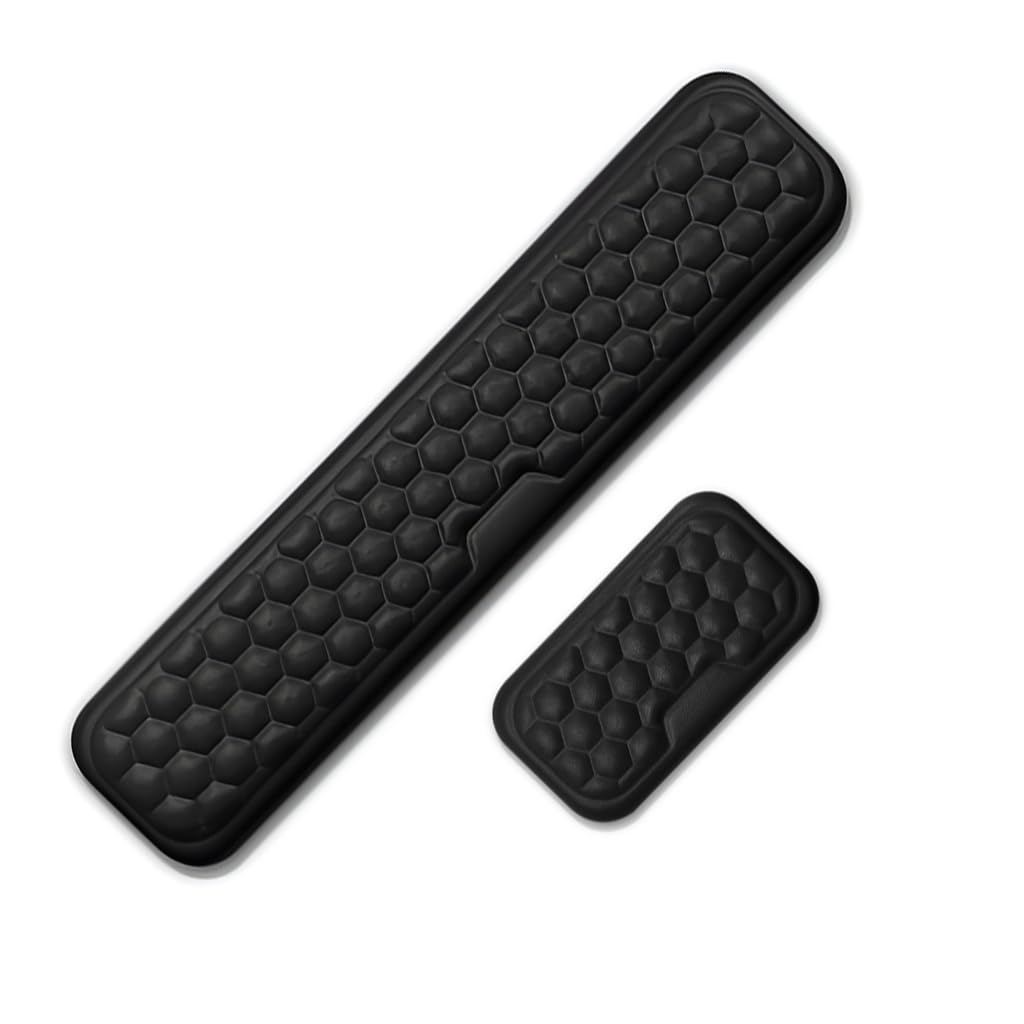
A wrist rest is a small pad that fills the gap between the edge of the desk and the bottom row of your keyboard, and a second one that sits under your hand at the mouse. It is one of the least glamorous things you can buy for a desk and one of the few that you feel on day one.
What a wrist rest is actually for
The name is slightly wrong, and the confusion causes most of the disappointment people have with these things. A wrist rest is not a place to park your wrists while you type. If you plant your wrists on a pad and then reach for keys by bending your hands sideways and pivoting from that fixed point, you have made your typing posture worse, not better.
It is a palm rest, and it is meant for the pauses. You type with your hands floating and your forearms doing the moving. When you stop to read something, your palms come down onto the pad instead of onto the hard edge of the desk. That edge is the real problem: a thin line of pressure across the soft underside of your wrist, held for hours.
The second job is height. A keyboard has thickness, so its keys sit above the desk surface. Without a pad your hands angle upward at the wrist to reach them. A rest of roughly the right height brings the resting surface up to meet the keyboard and keeps the hand more or less in line with the forearm, which is the position that costs you the least.
The things that actually matter
Where it genuinely helps
The clearest case is a desk with a sharp front edge. Glass tables, laminate desks with a square lip, and most of the cheap work-from-home tables sold during the last few years all press a hard line into the base of the palm. Padding that line is a real change and it is immediate.
The second case is the mouse hand. Most people notice discomfort on the mouse side first, because that hand sits in one place for hours doing small repetitive movements rather than moving around a keyboard. A mouse pad with a raised wrist section is often the single most useful half of a set like this.
The third is that a pad gives your hands a defined home position. That sounds trivial. In practice it stops the slow drift where your keyboard ends up at the far edge of the desk and you spend the afternoon leaning forward to reach it.
Where it disappoints
A wrist rest will not fix a bad chair or a high desk. If your elbows sit below the level of the desk, your shoulders are doing the work and your wrists are just where you notice it. Chair height and desk height come first, always. Spending Rs 500 on a pad to solve a problem caused by a table that is 10 cm too tall is a way of postponing the real fix.
Foam packs down. A memory-foam pad used daily will lose some of its loft over a year or two and end up flatter and firmer than it started. This is normal and it is why these are consumables rather than furniture.
Fabric-topped pads get grubby. Between hand oils, sweat and the general dust of an Indian city, a light-coloured fabric wrist rest will look tired within months and most of them are not designed to be washed.
Who should skip it. If you use a laptop on your lap or on a stand with a separate keyboard placed well back from the edge, you may not be resting on anything sharp and the pad adds nothing. If you type with your hands genuinely floating and never rest them, you will not use it. And if you already have pain — numbness, tingling in the fingers, pain that wakes you at night — a foam pad is not the answer and you should see a doctor. This is general information, not medical advice.
Getting it set up properly
Sit down first and get the chair right before you think about the pad. Feet flat, elbows at roughly the same height as the keyboard, shoulders down. Then place the keyboard so your forearms come in straight rather than angling inward.
Put the rest right up against the keyboard with no gap. A gap means your palm lands on the pad, then the desk, then the keyboard, which defeats the point.
Then watch yourself for a day: notice how often your hands are actually down on it. If it is most of the time while typing, you are anchoring, and you want to consciously lift your hands and move from the forearm while typing, settling down only between bursts.
Clean it. Wipe a silicone or leatherette pad weekly. For fabric, a slightly damp cloth with mild soap and a long dry in the shade is about as far as you should push it.
The one we have listed
We currently list a Memory Foam Keyboard and Mouse Wrist Rest Set at Rs 499 on Amazon.in. It is a two-piece set — a long pad for the keyboard and a smaller one for the mouse — in memory foam with a non-slip base. It carries a 4.4 star rating from 80-odd ratings, so treat that number as an early signal rather than a settled verdict; it is a much smaller sample than the ratings you will see on older listings.
Check your keyboard height against the pad thickness before you commit. That mismatch is the most common reason one of these ends up in a drawer.
If the wrists are one part of a general desk tidy-up, the other two things worth looking at are what your chair rolls on and what your cables are doing. We also list rollerblade caster wheels for office chairs and an APPUCOCO cable management box.
Common questions
Do wrist rests prevent carpal tunnel syndrome?
There is no good evidence that they do. They reduce contact pressure from a hard desk edge, which is a comfort benefit. Posture, breaks and overall workload matter far more. If you have symptoms, see a doctor rather than buying a pad.
Memory foam or gel?
Foam moulds and feels softer; gel is springier and stays cooler against the skin. In a hot climate gel or silicone has an edge in summer. Neither is meaningfully better for your wrists.
Do I need one for a low-profile or laptop-style keyboard?
Usually not, or only a very thin one. Flat chiclet keyboards sit close to the desk, so the angle problem barely exists. What you may still want is padding for the desk edge itself.
How long does one last?
A year or two of daily use before the foam flattens noticeably. Fabric covers usually look worn before the foam gives out.
Disclosure: TechBelievers lists products from Amazon.in and other stores as an affiliate. If you buy through our links we may earn a commission, at no extra cost to you. Prices are checked periodically and change often on the store's own site.