Vertical Mice: What Changing Your Hand Angle Actually Fixes
You notice it around four in the afternoon. A dull, tired ache along the outside of the forearm, sometimes a tightness at the base of the thumb, occasionally a wrist that feels stiff when you turn a door handle. Nothing dramatic. It goes away overnight and comes back the next day at roughly the same time. For a lot of people who spend eight hours on a laptop, that ache is the first thing that makes them search for an ergonomic mouse.
This article is general information about a product category, not medical advice. If you have pain, numbness or tingling that persists, see a doctor or a physiotherapist rather than buying an accessory and hoping.
What a vertical mouse is doing differently
Hold your arm loosely by your side. Your palm faces inward, thumb up. That is your forearm at rest. Now put your hand flat on a table, palm down. To get there, the two bones in your forearm crossed over each other. That rotation is called pronation, and a standard mouse keeps you in it for most of the working day.
A vertical mouse is shaped so your hand rests at something closer to a handshake angle, typically somewhere between 50 and 90 degrees from flat depending on the model. The bones stop crossing. The muscles that hold the rotation stop working. You still move the mouse the same way, but you push it from the side of the hand rather than from a twisted wrist.
That is genuinely the whole idea. Everything else about a vertical mouse is a normal mouse: sensor, buttons, scroll wheel, wireless receiver. The shape is the feature.
The specs that matter
Where it genuinely helps
The people who report the clearest benefit are those with forearm and outer-wrist fatigue from long mouse-heavy days. Design work, spreadsheets, CAD, video editing, anything with hours of dragging and clicking. The change in forearm rotation is real and you can feel it within a few days.
It also helps people who mouse on a laptop at a table that is too high, which is most people working from home in India, where the dining table is the desk. A high surface increases the wrist extension angle, and a vertical grip reduces some of the strain that comes with it.
Where it disappoints
The first week is genuinely annoying. Your accuracy drops, you overshoot buttons, and you will be slower at everything. Most people settle in within five to ten working days. Some never do, and there is no way to know which group you are in until you try.
It does not help everybody. If your discomfort is in the fingers, the palm, or the thumb specifically, a vertical mouse may do nothing, because those are not caused by forearm rotation. Carpal tunnel symptoms in particular are about wrist extension and pressure, not rotation, and a vertical shape is only a partial answer at best.
Gaming is worse on one. The grip is not built for fast, precise flicks, and the button layout is generally not competitive. If you game seriously, keep a second mouse.
They are bulky. A vertical mouse does not slide into a laptop sleeve pocket, so it is a desk device rather than a travel one.
And it does not fix your workload. If the ache comes from twelve-hour days without a break, a differently shaped mouse changes the angle of the strain and not the amount of it. Breaks and screen height do more.
Skip one if you use a mouse for under two hours a day, if you already work mostly on a trackpad, or if your pain is sharp, spreading or waking you at night. That last case needs a professional, not a purchase.
Getting used to one
Set it up on a day when accuracy does not matter. Do not switch the morning of a big presentation.
Lower the sensitivity slightly for the first two days, then raise it above where you had your old mouse. The extra sensitivity is what stops you from sweeping the whole forearm across the desk.
Keep your elbow closer to your body than you did before. Vertical mice work best with the arm in, not out to the side.
Do not use a wrist rest that props your wrist up under a vertical mouse the way you would with a flat one. The point is a neutral forearm, and pushing the wrist upward reintroduces the extension you were trying to reduce.
Give it two full weeks before judging. One frustrating afternoon is not a verdict.
The one we have listed
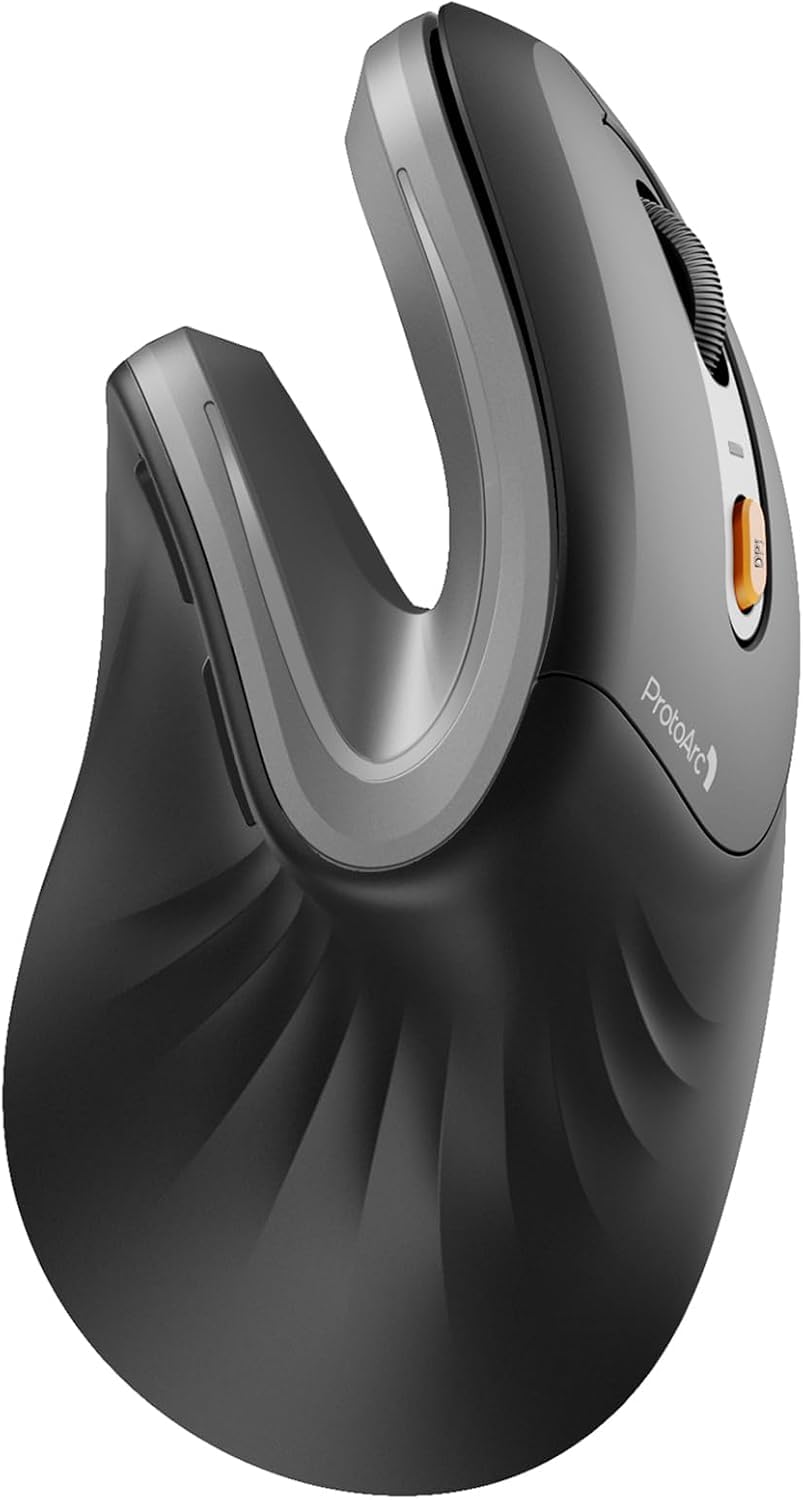
We have the ProtoArc EM11 NL Vertical Ergonomic Wireless Mouse listed at Rs 2,895, down from Rs 3,499, a 17 percent saving on Amazon.in. It is rated 4.4 out of 5 from more than 4,700 ratings, which is an unusually deep review base for an ergonomic accessory and worth something on its own, since it means the shape has been tried by a lot of different hands.
It is rechargeable, uses silent clicks, connects over both Bluetooth and 2.4GHz, pairs with up to three devices, and switches DPI up to 2400. The multi-device pairing is the practical part if you keep a work laptop and a personal machine on the same desk.
Rs 2,895 is a fair mid-range price for this category. Cheaper vertical mice exist and many are fine, but they tend to be a single connection type with non-rechargeable batteries.
Two related listings worth a look: a memory foam keyboard and mouse wrist rest set if your discomfort is at the keyboard rather than the mouse, and a plain wireless Bluetooth mouse if you decided the vertical shape is not for you but the laptop trackpad is the actual problem.
Common questions
How long does it take to get used to?
Usually five to ten working days for speed to return to normal. Comfort improvements, if they come, are often noticeable sooner than accuracy is.
Will it cure my wrist pain?
It might reduce forearm rotation strain. It is not a treatment, and it will not address pain caused by workload, posture or an existing condition. Persistent pain is a reason to see a doctor.
Is a vertical mouse good for gaming?
Not really. The grip is not suited to fast aiming and the button layout is usually basic. Use a conventional mouse for games.
Left-handed or small hands?
Most vertical mice are shaped for right hands, and left-handed versions are a separate product with limited choice. If you have small hands, check the dimensions carefully, because an oversized body will make you grip rather than rest.
Disclosure: TechBelievers lists products from Amazon.in and other stores as an affiliate. If you buy through our links we may earn a commission, at no extra cost to you. Prices are checked periodically and change often on the store's own site.