Water flossers: what they clean and what they do not
You finish a plate of chicken biryani, run your tongue along your back teeth, and there it is. Something wedged between the last two molars that is going to sit there and irritate you for the next three hours. There is a roll of dental floss in the bathroom drawer, bought with real intentions in about March, still nearly full.
That gap between what people intend to do and what they actually do is the whole reason water flossers sell. Not because a jet of water is better than string in some absolute sense, but because people keep using one.
This is general information, not medical advice. If you have gum disease, implants, loose crowns or ongoing dental treatment, ask your dentist what is right for your mouth before changing your routine.
How a water flosser actually works
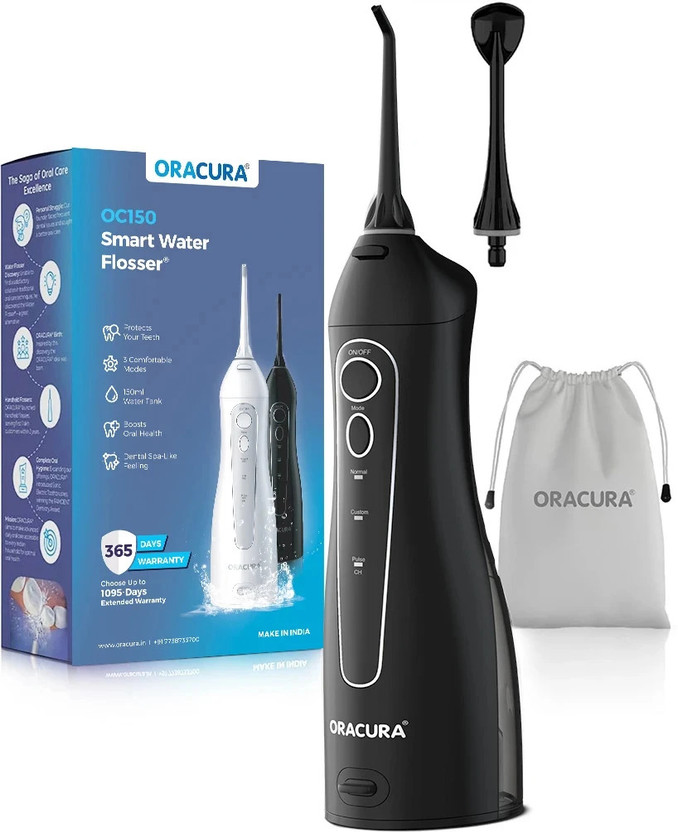
The device holds water in a small tank, and a pump pushes it through a narrow nozzle in rapid pulses rather than a steady stream. You aim the nozzle at the gum line and trace along it, holding the tip roughly at a right angle to the tooth, letting the water run out of your mouth into the sink as you go.
The pulsing matters. A continuous jet mostly just sprays. Pulses create a repeated push-and-release at the gap that flushes loose debris out from between the teeth and along the gum margin. Most units run somewhere between a low pressure setting suitable for sensitive gums and a firmer one for a normal clean.
Cordless models, which is nearly everything sold in India for home use, put the tank, pump and battery in one handle. Countertop models keep a large reservoir on the sink and connect by a hose. Countertop units hold more water and run longer, but they own a permanent square of your bathroom counter, which in a typical Indian bathroom is not free real estate.
The specs that matter
Where a water flosser genuinely helps
Braces are the clearest case. Threading string floss under an orthodontic wire is genuinely difficult, and most people with braces quietly give up. A jet gets under the wire and around brackets without any threading at all.
Bridges, crowns and implants are the second case, for the same reason. String cannot pass through a bridge; water can go under it.
Crowded or overlapped teeth are the third. If your lower front teeth sit at angles, string floss either will not fit or shreds trying.
And then there is the plain behavioural case. A device that clears your gaps in about a minute, that you can use while half-awake, gets used most nights. Floss that requires winding string around two fingers and reaching to the back does not. Something you do five nights a week beats something better that you do five nights a year.
Where they disappoint
A water flosser does not scrape. Dental plaque that has been left to harden into tartar is stuck to the tooth, and no home jet removes it. That is a scaling appointment, not a gadget purchase. Anyone selling a flosser as a replacement for a dental cleaning is selling you something untrue.
It does not replace brushing either. Different job entirely.
Whether it fully replaces string floss is genuinely debated. Water is better at flushing loose food and reaching awkward spots. String is better at physically wiping the flat contact surface where two teeth touch. Plenty of dentists suggest using both if you can manage it, and a water flosser if you know you will not.
Then there is the mess. The first two or three sessions, you will spray the mirror. The trick is to lean well over the sink, put the tip in your mouth before switching the unit on, and keep your lips almost closed so water dribbles out rather than jets out. It becomes automatic quickly.
Small tanks also mean refills. A 150ml tank is one fill for most people and two if you are thorough.
Practical usage and maintenance
Use lukewarm water. Cold water on a sensitive tooth is its own small punishment.
Do not put mouthwash in the tank as a routine unless the manual explicitly allows it. Alcohol-based rinses degrade the seals over time.
Empty the tank after every use. A sealed tank of standing water in an Indian summer bathroom grows things. Leave the lid open to dry.
If you are on hard water, and much of urban India is, mineral scale builds up in the pump over months. A monthly flush with a tank of diluted white vinegar, run through until empty, then a plain water tank to rinse, keeps it clear. If scale is a recurring theme in your home, a TDS meter tells you roughly what you are dealing with, and a shower filter addresses the same water elsewhere in the bathroom.
Expect some bleeding in week one if you have not flossed in a while. If it is still bleeding after two or three weeks, that is a reason to see a dentist rather than to turn the pressure up.
The one we have listed
The ORACURA Smart OC150 Lite Cordless Water Flosser has a 150ml tank, is IPX7 waterproof and charges over USB. It is listed at Rs 2,119 on Flipkart, down from Rs 2,650, and rated 4.2 stars from 470+ ratings.
That rating is worth reading honestly. 4.2 is good, not spectacular, and the usual complaints on cordless flossers in this bracket are battery life and nozzle wear rather than the jet itself. At roughly a third of what imported units cost, it is a reasonable way to find out whether you will actually stick with the habit before spending more. Prices change, so check Flipkart before ordering.
Common questions
Can I stop using string floss?
If you were never using it, this is a clear upgrade. If you already floss properly every night, a water flosser adds convenience and reach rather than replacing the wiping action of string.
Is it safe with braces or implants?
Generally yes, and it is one of the strongest use cases. Start on the lowest pressure. Confirm with your dentist if you have had recent work done.
Why are my gums bleeding?
Common in the first week or two when gums are inflamed from not being cleaned. If it continues beyond that, or is heavy, see a dentist.
Who should skip it entirely?
If you already floss consistently, have no braces or bridges, well-spaced teeth and no gum trouble, you are unlikely to notice much. Spend the money on a scaling appointment instead.
Disclosure: TechBelievers lists products from Amazon.in and other stores as an affiliate. If you buy through our links we may earn a commission, at no extra cost to you. Prices are checked periodically and change often on the store's own site.