Under-Desk Footrests: What They Fix and What They Do Not
The ache at six in the evening is usually a geometry problem
You bought the chair. You adjusted the armrests, tilted the backrest, added a lumbar cushion. And around six in the evening your lower back still hurts in exactly the same spot it always did.
The chair may never have been the problem. Almost every desk sold in India sits at roughly 75 centimetres, a height standardised for a taller average build than most people here have. If you are around 5 feet 4 inches and you raise your chair until your forearms sit level with the desk, your feet stop reaching the floor properly. Your thighs take the load instead of your feet, the seat edge presses into the back of your legs, your pelvis rolls backward and your lower spine loses its curve. That slow collapse over eight hours is what your back is complaining about.
A footrest is the boring fix. It raises the floor to meet your feet so the chair can stay at the height your arms actually need.
What a footrest is actually doing
It restores your hip angle. The target most ergonomists work towards is knees level with your hips or a little lower, with the whole sole supported. When feet dangle, that angle closes past ninety degrees and the pelvis tips back. A platform of the right height reopens it.
It gives your feet something to push against. Feet planted on a firm surface let you brace slightly and shift your weight without recruiting your back to do it. Dangling feet remove that option, so every small adjustment travels up your spine instead.
It lets you move. A tilted platform means you can rock your ankles and flex your calves without standing up. Sitting still is the real enemy, not sitting itself.
The specs that matter, and why
Where a footrest genuinely helps
Shorter people at standard desks get the most out of one, often within a week. If your feet do not sit flat when your elbows are at desk height, you are the target buyer.
Renters benefit too. You cannot cut the legs off a landlord's table, and a height-adjustable desk is a ten-thousand-rupee decision. A footrest costs a fraction of that and moves house with you.
It also helps people who fidget. If you catch yourself crossing your legs, tucking a foot under you or propping one foot on the chair base, your body is already asking for a footrest. Those improvised positions are the ones that put a twist in the hips. If your chair also rolls badly on tiles and you keep bracing to stay put, a set of better caster wheels is a cheaper first fix than either.
Where footrests disappoint
They do very little for neck and shoulder pain. That is a monitor height and mouse position problem, and no amount of foot support fixes a screen that sits too low.
They make things worse if the height is wrong. Too tall and your knees rise above your hips, which loads the tailbone and can aggravate sciatic pain. This is the most common way people end up disliking a footrest, and it is why single-height models are a gamble.
Tall users mostly do not need one. If you are around 5 feet 10 inches or above, your feet already reach the floor and adding height just closes your hip angle for no benefit. Put the money towards monitor height instead.
And nothing fixes an eight-hour block of sitting. The strongest evidence for desk comfort points at breaking up sitting time, not perfecting the posture you sit in. A footrest makes the sitting less bad; standing up every forty-five minutes does more.
This is general information about desk setup, not medical advice. Persistent back, hip or leg pain deserves a proper assessment from a physiotherapist or doctor rather than a shopping decision.
Setting one up so it actually works
Set the chair first. Raise or lower it until your forearms are roughly parallel to the floor with your hands on the keyboard, ignoring your feet entirely. Only then slide the footrest in and pick the height that lets your whole sole rest flat with your knees level with or slightly below your hips.
Keep it close, under your knees rather than under the far edge of the desk. Pushed too far forward it stretches your legs out and undoes the point of it. And do not treat it as a permanent leg position: use it, take your feet off, put them back. Variety is the goal. Wash the cover every few weeks, because in an Indian summer with the fan running, fabric under a desk collects an impressive amount of dust.
The one we have listed
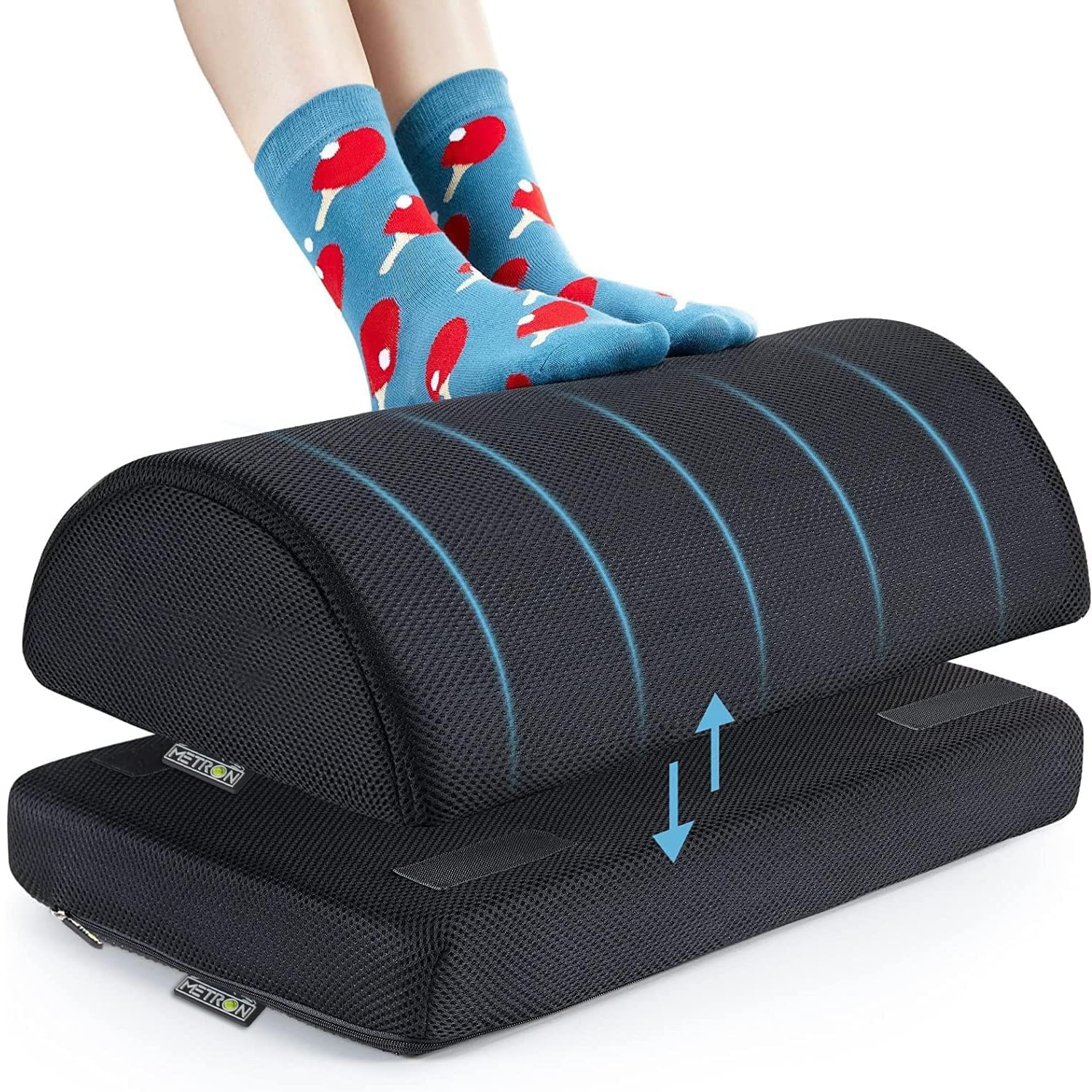
The Metron Dual-Height Under-Desk Footrest is currently listed at Rs 1,395 on Amazon.in, rated 4.3 stars across 1,400-plus ratings.
The reason it made our list is the flip. It switches between a 5-inch and a 7-inch height, which covers most of the range where people actually need help, and it angles rather than sitting flat. That adjustability is what separates a footrest that works from one that ends up in a cupboard. The cover is washable, which handles the dust problem.
Who should skip it: anyone tall enough to already sit flat-footed, anyone on a standing desk, and anyone whose under-desk space is already full. If your real complaint is wrist or forearm ache rather than back ache, a wrist rest set addresses that more directly for less money.
Common questions
Can I just use a stack of books?
For a week, yes, and it is a sensible way to test whether a footrest helps you before spending anything. What you lose is the tilt, the grip and the ability to change height, and cardboard collapses within a month.
What height should I get?
Sit with the chair set for your arms, then measure the gap between your heel and the floor and add an inch or two. Most people land between 4 and 7 inches, which is why a dual-height model removes most of the guesswork.
Will it stop me sitting cross-legged on my chair?
Often, yes. People sit cross-legged at a desk largely because their feet have nowhere comfortable to go. Give them somewhere and the habit tends to fade.
Does it help with feet swelling from long sitting?
Slight elevation and ankle movement both encourage circulation, so some people notice a difference. If swelling is regular or one-sided, that is worth a doctor's opinion rather than a footrest.
Disclosure: TechBelievers lists products from Amazon.in and other stores as an affiliate. If you buy through our links we may earn a commission, at no extra cost to you. Prices are checked periodically and change often on the store's own site.