TDS Meters: What That Number Actually Tells You About Your Water
Your RO has no way of telling you it has stopped working
The service technician came in March, took eighteen hundred rupees, changed something, and left. The water still comes out of the tap looking clear and tasting fine. That is the problem. An RO membrane does not fail loudly. It degrades, or it develops a small bypass, and the water on the other side looks exactly the same as it did when the unit was new.
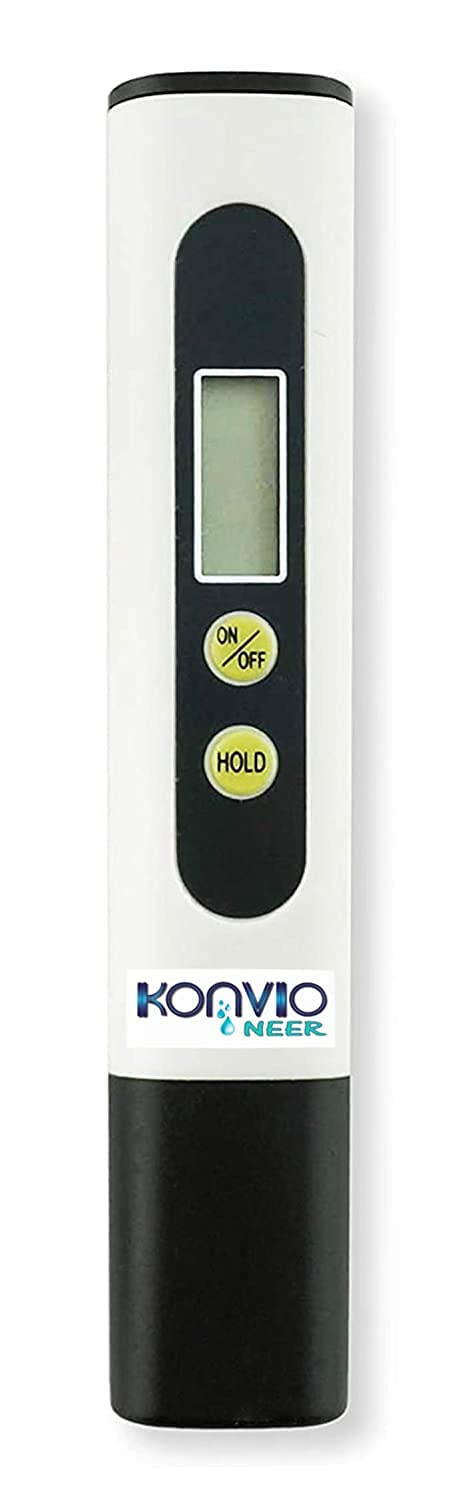
Meanwhile the annual service contract renews, the filter change reminder blinks on schedule, and nobody in the house has any evidence about whether any of it is doing anything. A three-hundred-rupee pen changes that. Dip it in a glass, read a number, and you know in five seconds whether the machine in your kitchen is still removing anything.
What TDS actually measures
TDS stands for total dissolved solids: the combined weight of everything dissolved in the water, measured in parts per million. Calcium, magnesium, sodium, chlorides, sulphates, bicarbonates, plus whatever else has gone into solution.
The meter does not weigh any of that. It passes a small current between two probes and measures how well the water conducts, then converts conductivity into an estimated ppm figure. Dissolved minerals carry charge; pure water barely conducts at all. More conductivity means more dissolved matter.
That distinction matters more than it sounds, and we will come back to it, because conductivity only sees things that carry an electrical charge.
Reading the number
Rough figures for context rather than as a standard:
The Bureau of Indian Standards sets an acceptable limit for drinking water at 500 ppm and a permissible upper limit of 2,000 ppm where no alternative source exists. Treat those as reference points, not as a verdict on your specific water.
The single most useful thing you can do with a meter is take two readings: the raw input to your purifier and the treated output. A working RO removes roughly 90 percent or more. If your tap reads 420 and your purifier gives you 380, the membrane is not doing its job, whatever the light on the front panel says.
What a TDS meter cannot tell you
This is the part that most product listings skip, and it is the reason to be careful about how you use the number.
It does not detect bacteria or viruses. Microbes are not dissolved solids and do not meaningfully change conductivity. Water with a TDS of 20 can make you seriously ill. A low reading says nothing about biological safety.
It does not identify what the solids are. A reading of 250 could be harmless calcium and magnesium, or it could include something you would rather not drink. The meter reports a total, not a composition. Heavy metals like lead and arsenic are usually present at concentrations far too small to move the number at all.
It misses anything uncharged. Pesticide residues, many industrial solvents and most pharmaceutical traces do not conduct, so they are invisible to conductivity.
A low number is not automatically better. Water stripped of all minerals tastes flat, and some of those minerals are dietary contributions you would otherwise get elsewhere. The chase for the lowest possible reading is a marketing artefact, not a health goal.
So a TDS meter is a very good instrument for one job — checking whether your filtration is working — and a poor instrument for the job people often buy it for, which is deciding whether water is safe. Safety requires a laboratory test that looks for specific contaminants.
This is general information, not medical advice. If you suspect your water is making people in your household unwell, get a proper laboratory analysis and speak to a doctor rather than relying on a pocket meter.
Where a meter genuinely earns its place
Deciding when to change an RO membrane, rather than changing it on a calendar. Take a baseline output reading when the membrane is new, then check monthly. When the output number starts climbing towards the input number, the membrane is done. That single habit can be worth more than the meter costs, in either direction: it stops premature replacements and it catches a failed membrane you would otherwise have drunk from for months.
Checking tanker water. In cities where supply is topped up by tankers, quality varies load to load. A quick reading tells you whether today's delivery is in the usual range or wildly off.
Diagnosing hard water complaints. If your geyser scales up, your washing machine struggles or your hair feels rough after a shower, a reading tells you whether hardness is plausibly the cause. It is worth knowing before you spend on a shower filter for hard water, so you find out afterwards whether it changed anything.
Aquariums and hydroponics, where dissolved solids are a parameter you actively manage rather than a proxy for anything.
Where it disappoints
Cheap meters drift. Calibration slips over months, and most inexpensive units cannot be recalibrated at home without a calibration solution. Treat the absolute figure as approximate and trust the comparison between two readings taken minutes apart far more than a single number taken in isolation.
Temperature affects conductivity. Most meters compensate automatically, but readings taken from a fridge-cold glass and a warm one may not match exactly.
The probes need rinsing between samples, and the battery is a small watch cell that will eventually die in a drawer while you are not looking.
And the honest limit: it answers one question well. If you wanted a verdict on your water, you have bought the wrong instrument.
The one we have listed
The Konvio Neer Digital TDS Meter is listed at Rs 299 on Amazon.in, down from Rs 699, rated 4.3 stars across more than 53,000 ratings.
Fifty-three thousand ratings is an unusually large sample for a product at this price, and it is most of why this one made our list. At Rs 299 the calculation is simple: one avoided unnecessary membrane replacement pays for it many times over. It also reads for aquarium and hydroponic use if you need it for that.
Who should skip it: anyone who wants to know whether their water is safe to drink, because this will not answer that. Anyone on a stable municipal supply with no purifier and no complaints has little to check. And if you already pay for an annual service contract that you trust and have no intention of questioning, the meter will only give you a number you do nothing with.
Common questions
What TDS is safe to drink?
TDS alone does not determine safety. As a general reference, BIS treats 500 ppm as the acceptable limit for drinking water, but a low reading does not rule out bacteria or heavy metals.
My RO output reads 15 ppm. Is that too low?
It is lower than most people prefer for taste, and it suggests any mineral-adding stage is either absent or exhausted. It is not dangerous. Many purifiers have a setting or cartridge that raises it.
How do I know if my membrane has failed?
Compare input and output. A healthy RO removes about 90 percent or more of dissolved solids. If output is within a third of input, something is wrong.
Do I still need one if I boil my water?
Boiling kills microbes but concentrates dissolved solids rather than removing them, so the TDS reading of boiled water goes slightly up, not down. The two address completely different problems.
Disclosure: TechBelievers lists products from Amazon.in and other stores as an affiliate. If you buy through our links we may earn a commission, at no extra cost to you. Prices are checked periodically and change often on the store's own site.