Sleep Earbuds: What They Actually Do For A Noisy Bedroom
It is 1:40am. The neighbour's generator kicked in after a power cut, a dog started up outside, and your partner is snoring in a rhythm you could set a metronome to. You are lying on your left side with a pillow folded over one ear, which works for about four minutes before your arm goes numb. Regular earbuds are out; lying on a hard plastic nub is its own kind of torture.
Sleep earbuds exist for exactly this situation. They are a narrow product solving a narrow problem, and they are widely misunderstood, mostly because people expect them to behave like the noise-cancelling earbuds they already own. They do not.
Masking is not cancelling
Active noise cancellation works by generating an inverted sound wave. It is very good at steady low-frequency drone, which is why it transforms a flight, and much weaker on sudden or high-frequency sound, which is why it barely touches a barking dog or a slamming gate.
Most sleep earbuds skip ANC entirely. They do two other things instead. First, passive isolation: a soft tip physically seals the ear canal, the same as an earplug. Second, masking: they play a continuous sound such as rain, brown noise or a fan hum, which raises the noise floor so intermittent sounds no longer stand out against silence. Your brain wakes to change, not to volume. A steady wash of rain at low level makes a snore less of an event.
This matters when you choose. If your problem is a constant hum, isolation alone may be enough and earplugs are cheaper. If your problem is unpredictable noise, masking is the thing that actually helps, and that is what the earbud format buys you.
The specs that decide whether you keep using them
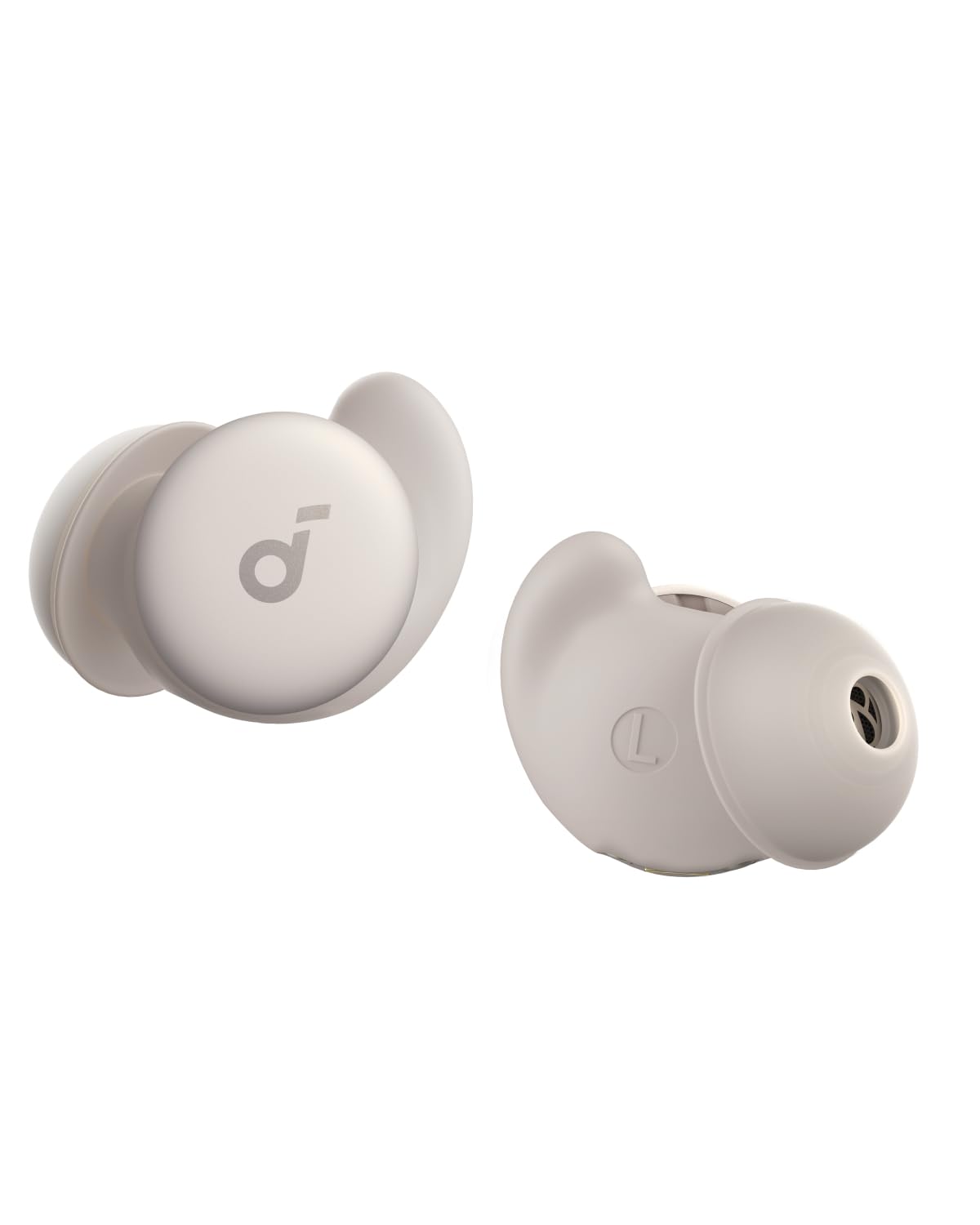
Profile height. The single most important number, and the one least often published. If the shell protrudes past the outer ear at all, a side sleeper will feel it pressing into the pillow within twenty minutes. Anything described as flush or ultra-low-profile is aiming at this.
Tip sizes included. Fit governs both comfort and isolation. A bud that seals for your friend may not seal for you. More tip options is a genuine feature.
Battery, in two numbers. Single-charge runtime has to cover a full night with margin, and case runtime tells you how often you are hunting for a cable. Ignore the marketing total and check both.
Onboard sound library versus streaming. If the sounds live on the buds themselves, your phone can be face-down across the room. If they only stream over Bluetooth, your phone stays awake in bed with you, which defeats a fair bit of the point.
Alarm behaviour. A silent alarm in the earbuds wakes you without waking the person beside you. If you share a bed with someone on a different schedule, this quietly becomes the best feature.
Whether they auto-stop. Some buds fade the sound after you fall asleep, some run all night. Neither is wrong, but you want to know which you are buying.
Where they genuinely help
- Side sleepers who cannot use normal earbuds at all.
- Snoring partners, where the noise is loud, close and irregular.
- Shift workers sleeping during the day through traffic, doorbells and construction.
- Anyone whose mind races at lights-out and who falls asleep faster with something to listen to.
- Shared flats and hostels, where the noise is other people and you cannot negotiate it away.
Where they disappoint
- Music quality. These are tuned for low-volume ambient sound in a tiny driver. Do not buy them to listen to albums.
- Heavy bass through walls. Low frequencies travel through the bed frame and your skull. No in-ear product fully stops a party downstairs.
- Ear soreness. Even a flush bud is a foreign object in your canal for eight hours. Some people adapt in a week, some never do.
- Price. They cost real money for a device that does one thing at one time of day.
- Losing them in the bedding. It happens more than you would think, and small dark objects and dark sheets are a bad combination.
- Anxiety about not hearing things. If you are the one who listens for a baby or an elderly parent, effective isolation is a downside, not a feature.
Living with them
Give any new pair two weeks before judging. First-night discomfort is normal and often disappears once you settle on the right tip size. Try the size you think is too small as well as the one you assume you need.
Clean the tips weekly. Warm water, dry fully, no alcohol on silicone. In a humid Indian summer, ear canals sweat and earwax softens, and a bud worn eight hours a night gets grubby faster than daytime earbuds ever do. If your ears itch or feel blocked, stop and let them air out for a few nights.
Charge the case during the day, not overnight. Obvious once said, easy to forget, and a dead bud at 2am is worse than never having had one.
Keep the masking volume low. The goal is to raise the noise floor just above the intrusion, not to drown it. Loud audio for eight hours a night is its own hearing risk.
None of this is medical advice. If you snore heavily yourself, wake gasping, or feel exhausted after a full night's sleep, that is a matter for a doctor rather than an accessory.
The one we have listed
We currently list the Soundcore Sleep A20 by Anker at Rs 12,499 on Amazon.in, rated 4 out of 5 and reviewed hands-on. It is built for sleeping and nothing else: an ultra-low-profile shell that sits flush enough for side sleepers to lie on, noise masking with a built-in library of sleep sounds, Bluetooth 5.3 if you want to stream your own audio, roughly 80 hours of runtime with the case, plus sleep tracking and a silent alarm that wakes only you.
SoundGuys and Android Police both confirmed the comfort and the side-sleeper fit in hands-on testing. Both also noted that music quality is modest and there is no ANC. That is a fair criticism only if you expected a general-purpose earbud, which this is not.
Skip it if your noise problem is a steady fan or air conditioner, in which case reusable earplugs at a fraction of the price will do the job. Skip it too if you sleep on your back and can already use normal earbuds, or if you need to stay alert for someone in the house.
Common questions
Do sleep earbuds block snoring completely?
No. They reduce it through a physical seal and then hide what is left under masking sound. A very loud snorer will still be faintly audible, but usually not loud enough to wake you.
Are they safe to wear all night?
For most people, yes, at low volume and with clean tips. Prolonged occlusion can contribute to earwax buildup or irritation. This is general information rather than medical advice; if you get pain, discharge or hearing changes, see a doctor.
Earplugs or sleep earbuds?
Earplugs if the noise is constant and your budget is tight. Sleep earbuds if the noise is irregular, or if you want audio, tracking or a silent alarm.
Will I still hear my alarm?
Your phone alarm may be muffled. Buds with their own alarm solve this properly, and it is worth checking that feature exists before you rely on it.
Disclosure: TechBelievers lists products from Amazon.in and other stores as an affiliate. If you buy through our links we may earn a commission, at no extra cost to you. Prices are checked periodically and change often on the store's own site.