Shower Filters for Hard Water: What They Fix and What They Do Not
You notice it on the taps first. A chalky white ring around the shower head, then a crust that will not come off with a sponge, then the spray pattern going crooked because half the holes are blocked. Somewhere in the same month you notice your hair feels like straw an hour after washing it, and the soap never quite rinses off your arms. If you are on borewell or tanker supply in Bengaluru, Hyderabad, Chennai, Pune or most of Delhi NCR, this is not your imagination. It is dissolved calcium and magnesium, and your skin is the last thing in the house to complain about it.
A shower filter is the cheap, tenant-friendly answer to that problem. It is also widely oversold. Here is what one actually changes.
What hard water is doing to your bathroom
Hard water carries dissolved minerals picked up from the ground. When that water evaporates on a surface, the minerals stay behind as scale. That is the white crust on your taps, the cloudy film on the shower screen, and the slow furring-up inside your geyser element.
The minerals also interfere with soap. Calcium reacts with soap to form an insoluble scum, which is why you rinse and rinse and still feel coated. That scum sits on skin and hair, and over weeks it makes hair feel rough and colour-treated hair fade faster. Chlorine, which most municipal supplies add for disinfection, adds its own drying effect on top.
How a shower filter actually works
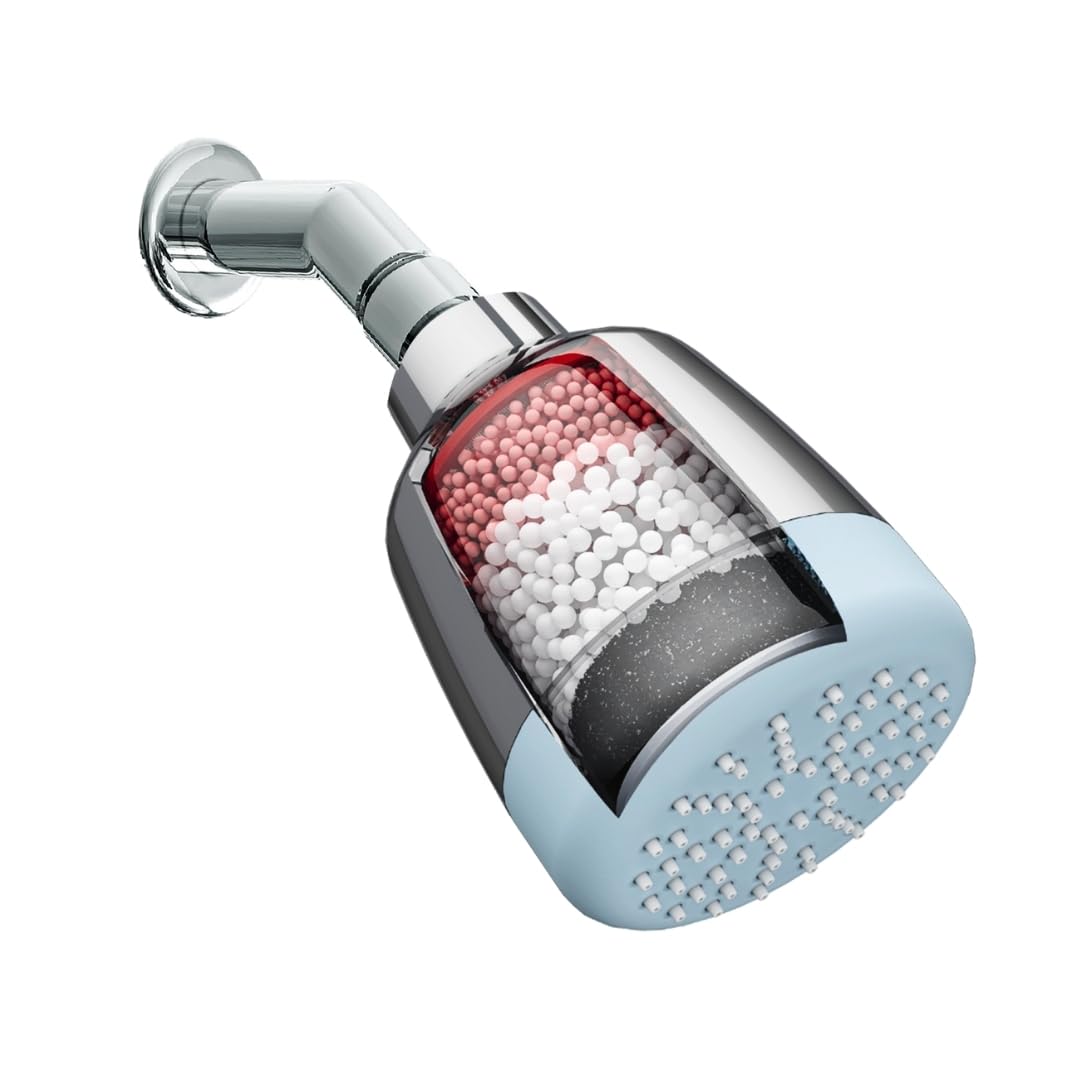
A point-of-use shower filter screws in between your existing pipe outlet and your shower head. Water passes through a cartridge on its way out. Depending on the design, that cartridge does some combination of three things:
That third point is the crux of the whole category. A shower filter is not a water softener. A real softener uses ion exchange resin, needs periodic salt regeneration, and costs tens of thousands of rupees installed at the tank. A ₹2,000 device screwed onto your shower arm is doing something much more modest.
The specs that matter
Cartridge life and replacement cost. This matters more than the purchase price. A filter that needs a ₹700 cartridge every three months costs you ₹2,800 a year forever. Check the replacement price and availability before you buy, not after.
Flow rate drop. Every filter restricts flow to some degree. If your building already has weak pressure on the upper floors, a filter can take a mediocre shower down to a dribble.
Thread compatibility. Indian shower arms are usually half-inch BSP. Most filters ship with adaptors, but if you have a rain shower on a fixed ceiling arm, or a concealed diverter, there may be no sensible place to fit one at all.
Whether you can see the cartridge. A clear housing is genuinely useful. It tells you when the media is spent instead of leaving you to guess.
Where a shower filter genuinely helps
If your water arrives visibly discoloured or gritty — common after a tanker delivery, or in the first monsoon weeks when borewell water churns up — a filter earns its money immediately. Catching sediment before it hits your shower head also stops the nozzles clogging, which is the single most common reason a shower head starts spraying sideways.
If your supply is heavily chlorinated, chlorine reduction makes a difference people notice within a week or two, usually as less scalp itch and less of that swimming-pool smell on a towel.
And it helps most in the situation it was designed for: you rent, you cannot touch the plumbing, and installing anything at the tank is out of the question. A filter you can screw on in ten minutes and unscrew when you move is a reasonable trade.
Where it disappoints
It will not soften your water in any meaningful sense. If your main complaint is scale building up on taps and tiles across the whole house, a shower filter fixes exactly one tap. Your washing machine, kitchen sink and geyser carry on as before. People who buy expecting a softener are the ones who leave two-star reviews.
The hair and skin claims are the softest part of the pitch. Some people report a clear improvement. Others report nothing. Water chemistry varies enormously street to street, so the same product genuinely performs differently for two buyers. Treat before-and-after photos in marketing material with the scepticism you would apply to any beauty product.
Cartridge cost is the slow disappointment. The device is a subscription in disguise, and if you stretch the cartridge past its life you are showering through a saturated filter that is doing very little.
Finally, low-pressure homes should think hard. If you already shower under a sad trickle, do not add a restriction to it.
On the skin and hair side: this is general information, not medical advice. Persistent itching, flaking or a rash is worth showing to a doctor rather than treating with a plumbing accessory.
Living with one
Wrap the threads with a couple of turns of PTFE tape and hand-tighten rather than cranking it with a wrench — the housings are plastic and they crack. Put a reminder in your phone for the cartridge change date.
If you are dealing with scale that has already formed elsewhere, a filter does nothing retroactively. Descaling existing crust is a separate job, and a cordless electric spin scrubber with a mild acidic cleaner handles tiles and glass far faster than a sponge. Hard water is also rough on appliances — if your washing machine has started walking across the floor as its bearings age, a set of anti-vibration pads is a cheaper first move than a service call.
The one we have listed
We list the WaterScience CLEO Shower Filter for Hard Water at ₹1,845 on Amazon.in. It holds 4.1 stars across 1,000+ ratings, which is a fair score for this category — good enough that it clearly works for most buyers, low enough that you can see the mismatched expectations in the review pile.
It fits between your pipe and your existing shower head, so there is no plumber and no tank-level installation. That is the entire appeal. At under ₹2,000 it is a rounding error next to a whole-house softener, and if you rent, it is the only version of this idea you can actually take with you.
Skip it if your pressure is already weak, if your real problem is scale throughout the house rather than in the shower, or if you are not willing to buy cartridges on schedule.
Common questions
Will this make my water safe to drink?
No. Shower filters are not designed or certified for drinking water. Keep your RO or UV unit for that.
How often do I replace the cartridge?
Depends entirely on your water and your usage. Heavily sedimented borewell supply exhausts a cartridge far faster than treated municipal water. Check the housing if it is transparent, and treat the manufacturer figure as an optimistic ceiling.
Can I fit it to a rain shower or a handheld?
Usually yes for a standard wall arm with a handheld or a normal head. Ceiling-mounted rain showers and concealed diverters often leave nowhere sensible to put it.
Is it better than just buying a softener?
A softener is far better at softening. It is also several tens of thousands of rupees, needs installation and salt top-ups, and you cannot take it with you when the lease ends.
Disclosure: TechBelievers lists products from Amazon.in and other stores as an affiliate. If you buy through our links we may earn a commission, at no extra cost to you. Prices are checked periodically and change often on the store's own site.