Ring Lights: What They Fix About Your Video and What They Do Not
You join the call at 4pm with the window behind you and the ceiling tube light off, because it is still bright outside. On your screen everyone else looks fine and you look like a silhouette with a voice. Turn on the tube light and it gets worse: a hard shadow under your nose, a green cast on your skin, and grain crawling all over the image because your webcam has given up trying.
That is a lighting problem, not a camera problem, and it is the single most common reason people look bad on video. A ring light is the cheapest fix for it. It is also frequently oversold, so it is worth separating what it does from what people claim it does.
Why a ring shape at all
A camera sensor needs light. When there is not enough, it compensates by raising gain, and raised gain is what produces the speckled noise you see in dim video. More light on your face means less gain and a cleaner picture. That is the primary job, and almost any light would do it.
The ring shape does something more specific. A bare bulb is a small point source, so it casts hard-edged shadows: a sharp line under the nose, dark hollows under the eyes. Spreading the same light around a wide circle makes it a large source relative to your face, and large sources wrap around edges instead of cutting across them. Shadows soften. Skin texture flattens out. Blemishes stop being outlined.
Placing the camera in the middle of that ring means the light comes from exactly where the lens is looking, so there is nowhere for a shadow to hide. It also puts a distinctive circular reflection in the eyes, which is why ring light footage is instantly recognisable once you know to look for it.
The specs that matter
Where it genuinely helps
Video calls in rooms without good window light, which in most Indian flats means anything after sunset or any room facing an interior corridor. It also helps enormously with laptop webcams specifically, because those sensors are small and noisy and benefit more from extra light than a phone camera does.
It helps for phone-shot reels, product close-ups and unboxing videos, where the ring plus tripod gives you a repeatable setup you do not have to rebuild each time. And it helps for anything where you want consistency across many recordings, since daylight changes by the hour and a lamp does not.
If you are on calls all day, pairing it with something that raises the camera to eye level makes more difference than either change alone. A laptop stand fixes the up-the-nose angle that no amount of good lighting can rescue.
Where it disappoints
Flat, front-on light is unflattering on many faces. It removes the shadows that give a face depth, which can make people look wide and slightly waxy. Professional setups almost always place the key light off to one side for this reason. If you want your video to look considered rather than merely bright, a ring light dead centre is not the goal.
Spectacle wearers get a visible circular reflection in each lens. Tilting the light higher and angling it down reduces it but rarely removes it entirely.
It only lights your face. If the wall behind you is dim, you end up as a bright head floating in a dark room, which reads as worse than being evenly dim. A second light or a monitor light bar for the desk surface fixes this more elegantly than turning the ring up higher.
And it is another object on an already crowded desk. Tripods take floor or desk space and cables run across it.
Who should skip it: anyone who sits facing a window during their working hours already has the best soft light available and does not need to buy one. Anyone who wears glasses on every call and cannot tolerate reflections should look at a softbox placed off to one side instead. And if your video quality problem is actually a slow internet connection, no light will fix compression artefacts.
Getting good results from it
Set it slightly above your eye level and angle it down about fifteen degrees. This keeps the eye catchlight natural, reduces glasses glare and avoids the under-lit horror-film look you get from placing it below your chin.
Match the colour temperature to the room, not to what looks best in isolation. If your ceiling light is warm, warm the ring too. Then turn the brightness down until it is just above the ambient level rather than fighting it, which is where most people go wrong.
Keep it about an arm's length away. Closer is softer but produces a hotspot on the forehead. Route the cable behind the desk, because a top-heavy tripod plus a taut cable is how these break.
The one we have listed
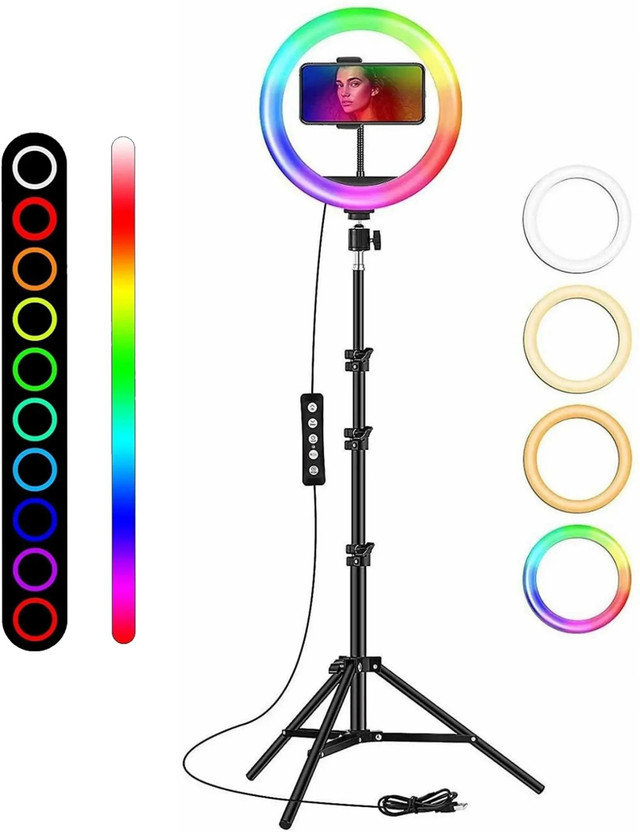
The Webilla 10-inch RGB Ring Light with Tripod is listed at Rs 742 on Flipkart. It is a 10-inch ring with colour-adjustable output, an adjustable tripod and a phone holder.
Ten inches is the useful size for one person at a desk, and the included tripod and phone holder mean it works for both calls and phone-shot video without buying anything extra. Worth noting: the listing does not carry a star rating yet, so there is no accumulated buyer feedback to lean on. At this price the tripod will be lightweight rather than sturdy, which is normal for the category and worth planning around when you position the cable.
Common questions
Will a ring light improve a bad webcam?
Substantially, yes. Most webcam noise comes from the sensor boosting gain in low light. Add light and the grain drops. It cannot improve a soft lens or a low resolution.
Do I need the RGB colours?
For face lighting, no. White with adjustable warmth is what you will use. Colours are for lighting a background or for stylised video.
What size should I get?
Ten inches is the sensible default for one person at desk distance. Six-inch clip-ons are for travel and produce noticeably harder light. Eighteen-inch rings are for dedicated setups and take a lot of space.
Where should it go relative to my screen?
Directly behind or just above the camera, slightly higher than your eyes, angled down. Off to one side gives a more natural, shaped look if you prefer that over maximum evenness.
Disclosure: TechBelievers lists products from Amazon.in and other stores as an affiliate. If you buy through our links we may earn a commission, at no extra cost to you. Prices are checked periodically and change often on the store's own site.