Reusable Notebooks: Who They Actually Suit, and Who Should Just Buy Paper
Most people who take handwritten notes end up with the same pile: three or four part-used notebooks, one of which has the thing they need in it, and no way to find it without flipping pages. Typing everything solves the searchability problem and loses whatever it is about writing by hand that makes ideas stick.
Reusable notebooks are aimed squarely at that gap. You write normally, photograph the page with an app that sends it wherever you want, then wipe the page clean and use it again. The idea is neat. Whether it suits you comes down to some fairly specific details about how you work.
How they actually work
The pages are not paper. They are a synthetic sheet with a smooth coating that ink sits on top of rather than soaking into. You write with an erasable gel pen, usually a Pilot FriXion, whose ink is thermochromic — it becomes colourless above roughly 60 degrees Celsius. Wiping with a damp cloth lifts it off the coated surface entirely.
At the bottom of each page sits a row of small symbols. You tick one before scanning, and the app reads it as a routing instruction: this symbol means Google Drive, that one means email, another means Dropbox or Slack. Scan the page and it lands in the right folder without you filing anything.
That routing is the part that makes it more than a gimmick. It is the difference between a photo sitting in your camera roll and a note that has already filed itself.
What it feels like to write on
This is the thing you cannot judge from a listing, and it is the most common reason people abandon these notebooks.
The surface is slicker than paper. Some people find it pleasant and fast. Others find the pen skates and their handwriting deteriorates. There is no drag, none of the slight resistance that good paper gives you. If you are particular about how a pen feels, this is a genuine consideration.
The ink also needs a few seconds to set. Rest your palm on a line you wrote moments ago and you will smudge it. Left-handed writers notice this considerably more than right-handed ones.
The heat problem, which is not a small thing in India
The ink disappears above about 60 degrees. A car parked in the sun in Ahmedabad in May comfortably exceeds that inside the cabin. So does a bag left on a sunny windowsill, or a page pressed under a hot laptop.
People do lose notes this way. The saving grace is that the ink returns when cooled well below freezing, so a few hours in the freezer often brings a blanked page back. That works, and it is also a genuinely strange thing to have to do to your notebook.
The practical rule: scan pages the same day you write them, and never leave the notebook in a parked car.
Where it genuinely works well
Where normal paper wins
The maintenance nobody mentions
Wiping is not quite as instant as the marketing suggests. Ink left on a page for weeks gets harder to remove and can leave faint ghosting. Wiping regularly rather than letting pages sit is the trick, and using a barely damp microfibre cloth rather than a soaking one, since water pooling at the spine is what damages the binding over time.
The pens are consumable. FriXion refills are widely available in India and cheap, but factor them in. And the cover is the most common durability complaint across reviews of these notebooks, so if it lives loose in a bag, expect wear.
The one we have listed
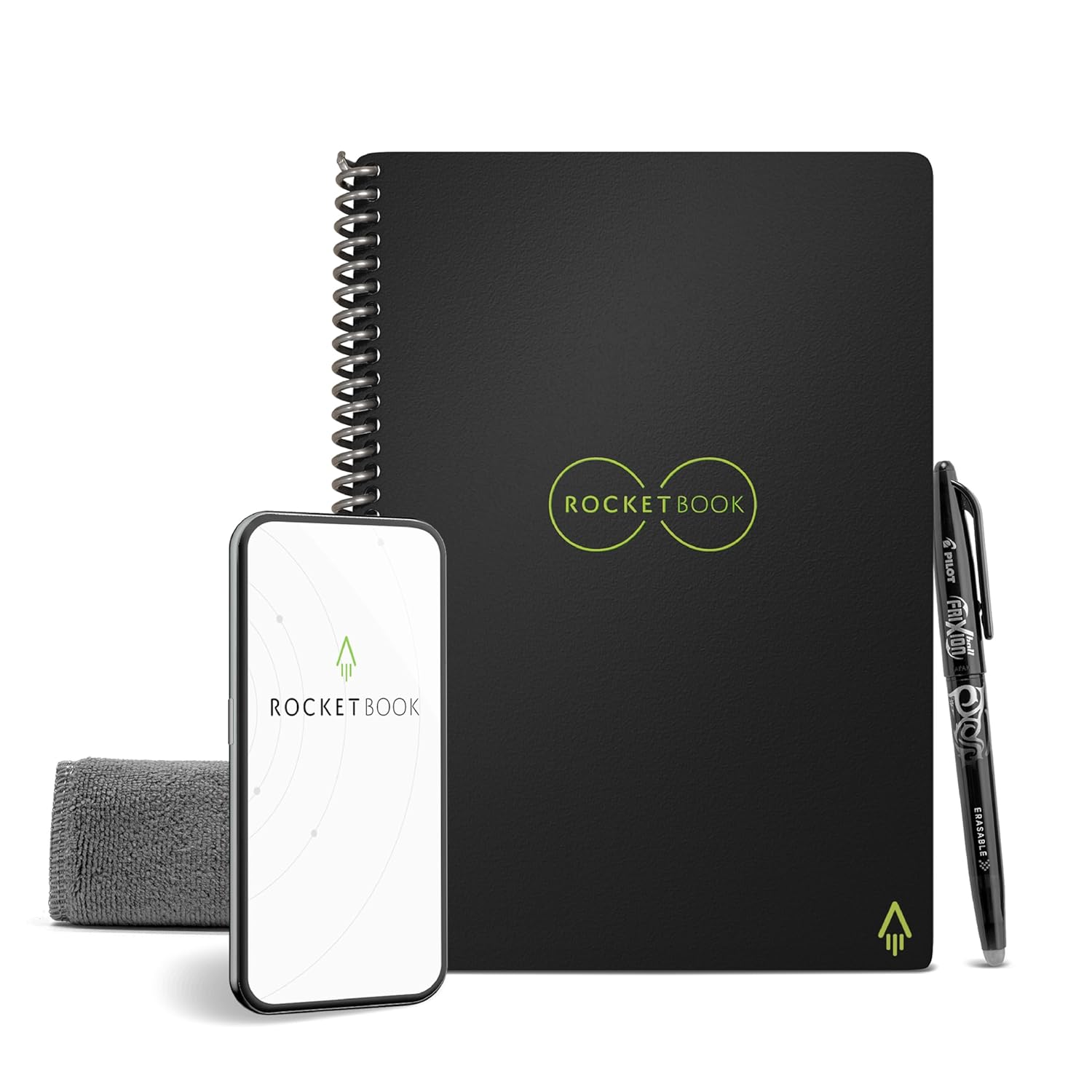
The Rocketbook Smart Reusable Notebook in Executive A5 is on our deals list at Rs 6,240 on Amazon.in. It ships with a Pilot FriXion pen and a microfibre cloth, and the app handles the symbol routing to Google Drive, Dropbox, email, Slack and several other destinations.
Rocketbook is the established name here and the app is the reason. Cheaper reusable notebooks exist on Amazon.in for a third of the price, and the pages are broadly comparable; what you are paying extra for is scanning software that reliably deskews a page, cleans up the background and files it correctly. If the routing workflow is not something you will use, a cheaper alternative makes more sense.
Two honest caveats. Rs 6,240 is a lot to spend before knowing whether you like writing on the surface, and cover durability is the recurring gripe in reviews. If you can, handle one before committing.
Common questions
How many times can a page really be reused?
Manufacturers quote figures in the hundreds. In practice the pages outlast the cover. Faint ghosting can build up on heavily used pages over a year or two.
Can I use any erasable pen?
Any Pilot FriXion works, including the highlighters and the fineliner versions. Ordinary ballpoint or gel ink will not wipe off and will ruin the page permanently.
Does the app read my handwriting?
Rocketbook's app can transcribe handwriting for searching, with accuracy that depends heavily on how neat you are. Do not buy it expecting perfect transcription of messy notes.
Is it good for students?
Mixed. Good for lecture notes you digitise and clear weekly. Bad for anything you need to keep as a physical record all year, and the upfront cost is hard to justify against a stack of cheap notebooks.
Disclosure: TechBelievers lists products from Amazon.in and other stores as an affiliate. If you buy through our links we may earn a commission, at no extra cost to you. Prices are checked periodically and change often on the store's own site.