Resistance Bands: What They Build and What They Cannot
The treadmill in the spare room became a clothes rack in about six weeks. The gym membership lapsed in March. What survived, in a lot of Indian homes, is a rubber tube in a drawer that gets pulled out three times a week because it takes four seconds to start using. That is the honest appeal of a resistance band: not that it is the best training tool, but that it is the one with almost no friction between deciding to train and training.
This is general information, not medical advice. If you have a joint injury, a heart condition, or you are returning to exercise after a long gap, talk to a doctor or physiotherapist before starting.
How band resistance actually works
A dumbbell gives you the same load through the whole movement — a 10 kg weight is 10 kg at the bottom of a curl and 10 kg at the top. A band does not. The further you stretch it, the harder it pulls back. Physiotherapists call this an ascending resistance curve, and it changes the character of every exercise.
In practice that means the hardest part of a band exercise is the end, where the band is longest. For some movements this matches your body well: your arm is strongest at the top of a row or a chest press, so it is useful to have the load peak there. For others, like a squat, it works against you — the band is loosest at the bottom, which is exactly where a squat is hardest.
The second consequence is that a band has no weight of its own. Nothing falls on you, nothing has to be racked, and you cannot drop it on your foot. That makes bands unusually safe to train alone at home, which matters if you are exercising in a small flat with nobody around.
The types, and which one you want
Buying advice that saves money: one heavy band plus a shorter grip position beats owning five bands. You change the resistance by changing how much slack you start with — stand further from the anchor, or wrap the band once around your hand, and the same band becomes considerably harder.
Where bands genuinely help
Upper-back and rear-shoulder work is where they shine, and it is also the area most desk workers are weakest. Band pull-aparts, face pulls and single-arm rows load exactly the muscles that a day at a laptop lets go slack, and they need no anchor point more elaborate than a door handle.
Travel is the second real case. A band weighs less than a paperback and flattens into a laptop bag. Anyone who spends weeks on site or in hotels gets more training out of a Rs 200 band than a Rs 20,000 gym membership they use four days a month.
Third, warm-ups and mobility. Even people who lift seriously use light bands before a session, because a band is the easiest way to move a joint through its range with a little tension.
And for genuine beginners, bands lower the barrier in a way that matters more than the physics. If you have never trained, the movement pattern is the thing to learn first, and a band lets you learn it without a barbell.
Where they disappoint
Legs. This is the honest limitation. Your quads and glutes can handle loads that no reasonable band arrangement produces. You can make squats and lunges harder with a band, but you will hit a ceiling within a couple of months and there is no way past it except adding real weight.
Progress tracking is vague. With dumbbells you know you moved from 8 kg to 10 kg. With bands you know you stood "a bit further back", which is not a number. People plateau on bands partly because they cannot tell they have stopped progressing.
Bands also degrade, and they degrade invisibly. Latex is damaged by sunlight, heat and oil. A band left on a sunny windowsill through a Delhi summer can look fine and snap on the fifth rep. When a tube band fails under tension it whips back, and the handle end can catch you in the face. Check for tiny surface cracks, chalky patches or thin spots each time you pick it up, and retire anything that looks tired.
Who should skip one: if you already have adjustable dumbbells or a gym you actually attend, a band adds little except convenience. And if your goal is specifically to build significant lower-body strength, a band is not the tool — buy or borrow weight.
Looking after it
Keep it out of direct sun and away from heat. A drawer is ideal; a hook near a window is the worst option. Do not store it stretched or knotted, because latex takes a set and thins at the fold.
Wipe it down if you have been sweating heavily — salt and skin oils break latex down faster than use does. During the monsoon, dry it properly before putting it away; a damp band in a closed drawer grows mould on the fabric-covered types.
Never anchor a band to something that can move or shatter. Door handles are fine if the door is shut and latched and opens away from you. Grille bars and heavy furniture legs work. Anything glass, plastic or on castors does not.
The one we have listed
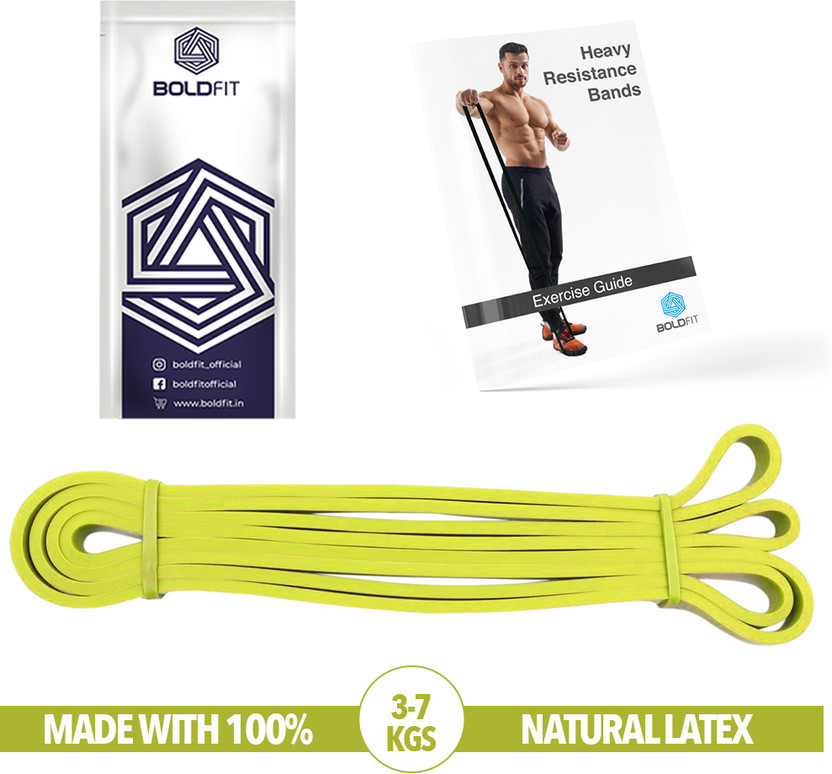
We list the Boldfit Heavy Resistance Band at Rs 178 on Flipkart. Boldfit is a familiar Indian fitness brand, and this is the heavy tube version, intended for strength work, stretching and mobility rather than light rehab.
At under Rs 200 the calculation is simple: it costs less than two coffees and it takes up no space. If you use it twice a week for six months, it has paid for itself many times over. If it ends up in the drawer, you have lost almost nothing. That is a better risk profile than most home fitness purchases. If you are building out the recovery side too, the Bolt deep tissue massage gun and the Sifoz posture corrector are the two other items in this category we have written about honestly, including where they fall short.
Common questions
Can I build muscle with only a resistance band?
In the upper body, yes, particularly if you are new to training — muscle responds to tension and effort, not specifically to metal. In the lower body you will run out of usable resistance fairly quickly.
What resistance level should I start with?
Most people over-buy. If you can do 15 clean reps of a row with good control and the last two are hard, that is the right band. Remember that stepping further from the anchor increases resistance, so a single heavy band covers a wide range.
How long does a band last?
With regular use and sensible storage, roughly a year to two. Sun and heat shorten that dramatically. Treat it as a consumable rather than equipment.
Is a band safe if I have a bad shoulder or knee?
Bands are widely used in physiotherapy, but the right exercise depends entirely on the specific problem. Get an assessment first rather than copying a routine from a video.
Disclosure: TechBelievers lists products from Amazon.in and other stores as an affiliate. If you buy through our links we may earn a commission, at no extra cost to you. Prices are checked periodically and change often on the store's own site.