Plug-In Energy Meters: Which Appliance Is Eating Your Bill
The bill lands at Rs 4,700 and the guessing starts. Someone blames the AC. Someone else says the geyser has been left on all morning again. The old fridge in the corner gets accused every summer. Nobody actually knows, because the electricity board sends one number for the entire house and no breakdown of where it went.
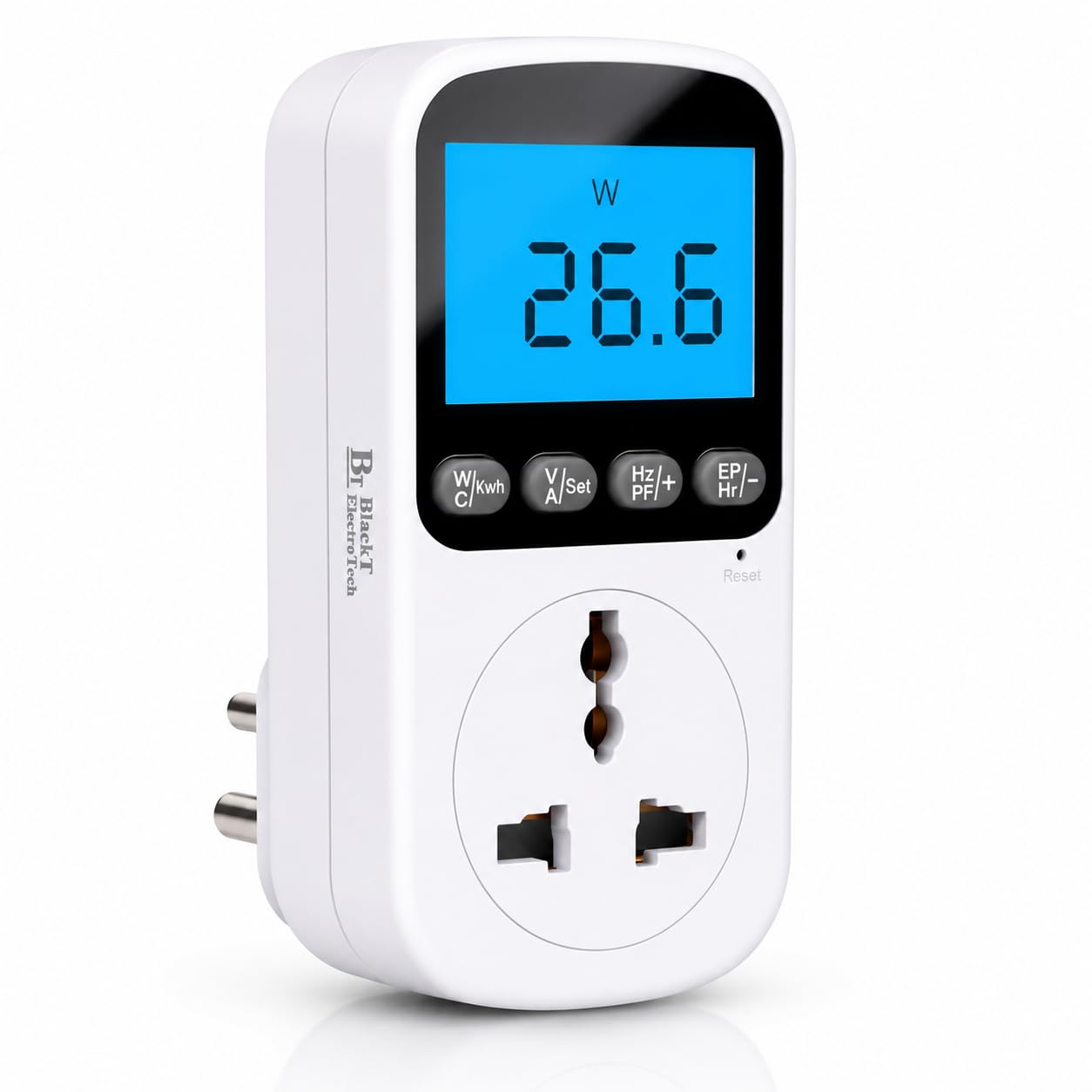
A plug-in energy meter ends that argument. It is a small block that sits between the wall socket and one appliance and counts the electricity passing through it. Leave it on the geyser for a week and you know what the geyser costs. Move it to the fridge and repeat. It is the least exciting diagnostic tool you can own, and one of the few that can pay for itself inside two months.
What the meter is actually measuring
Two different things, and people confuse them constantly.
The first is live power draw, in watts. That is how hard the appliance is pulling right this second. The second is energy consumed, in kilowatt-hours — the units your bill is written in. One unit is 1,000 watts drawn for one hour.
The gap between those two is why the sticker on the back of an appliance misleads people. A 2,000-watt geyser does not consume 2,000 watts continuously. It heats until the thermostat cuts out, sits idle, then heats again. A fridge rated at 200 watts might average 60 over a day because the compressor runs in cycles. An LED TV pulls almost nothing while playing and a small trickle when off but still plugged in. Rated wattage tells you the peak. Only a running kWh total tells you the cost.
So the number that matters on the display is the units counter, and it only becomes useful after the meter has been sitting on one appliance for long enough to catch a normal cycle of use.
The specs that actually matter
Where it genuinely helps
Standby drain is the classic find. A set-top box, a WiFi router, an inverter on trickle charge and a TV left on standby can together run at 30 to 50 watts around the clock. That is quietly a few hundred rupees a month for nothing.
It settles appliance arguments with data. Is the geyser or the AC the bigger line item? Run the meter on each for a week and you will have the answer instead of an opinion.
It tells you whether an old appliance is worth replacing. A fifteen-year-old fridge that eats 2.5 units a day against a new one that eats 1 is a real calculation you can now do, rather than a shop assistant's claim.
It also helps when you rent. Plenty of tenants pay a flat per-unit rate set by a landlord with no sub-meter to check against. A plug meter on your own appliances at least tells you whether that number is plausible.
Where it disappoints
The biggest limitation is structural: it can only measure things that plug in. Ceiling fans, tube lights, most split ACs, wall-mounted geysers wired to a dedicated point — all hardwired, all invisible to a plug meter. In many Indian homes those are exactly the loads you most want to see. If your AC is on a hardwired point, this device cannot help you with it.
Accuracy at very low loads is poor. A 3-watt phone charger may register as zero. These are not laboratory instruments; treat the reading as being in the right neighbourhood rather than exact, and do not use one to win a legal dispute.
Basic units have no app and no logging. You walk over and read an LCD. If you wanted graphs on your phone, that is a different and more expensive category of device.
They are also bulky enough to block the socket beside them on a board. And the obvious one: the meter saves you nothing on its own. It produces a number. Acting on it is still your job.
How to run the test so the numbers mean something
One appliance at a time, for a full week where possible. Note the units reading when you start and when you stop, and subtract.
For a fridge, give it at least 48 hours — a shorter window will catch either too many compressor cycles or too few and skew the average badly. For a geyser, a week covers the normal rhythm of who bathes when.
Set your real tariff before you begin, not after. Some meters recalculate cost retroactively and some do not.
Avoid running it through an extension board unless you deliberately want the combined total of everything on that board — which is actually a fast way to catch standby drain across a whole entertainment setup in one go.
Finally, after the first overnight power cut, check that the counter survived. If it reset, you have learned something important about the unit and can plan around it by taking daily readings instead of weekly ones.
The one we have listed
The Blackt Electrotech BT72PM3 Plug-In Energy Meter is a 3-pin, 230V unit built for Indian sockets, listed at Rs 989 on Amazon.in. It carries a 4.3 star rating across 269 ratings. It shows live watts, voltage, units consumed and running cost on an LCD, and needs no app, no wiring and no electrician — you plug it in between the socket and the appliance and read the screen.
If what you actually want is not to measure the geyser but to stop it running for two hours unattended, an automatic cut-off timer switch solves that problem directly instead. And if the loads you want to control are spread across a room, a remote control switch board is a different answer to a related question.
Common questions
Will it work with my air conditioner?
Only if the AC plugs into a socket and its draw sits within the meter's load rating. Window units on a 16A plug point are usually fine. A split AC on a hardwired dedicated point cannot be measured this way at all.
Does the meter itself use much electricity?
No. The display and internal circuitry draw a fraction of a watt, which is negligible against anything you would bother measuring.
Can it tell me my whole house consumption?
Not from a socket. Whole-home monitoring needs a clamp meter or a smart meter installed at the mains, which is a different product and usually an electrician's job.
How long before it pays for itself?
That depends entirely on what you find and whether you act on it. Finding 40 watts of permanent standby drain and killing it saves roughly 29 units a year, which at typical urban tariffs is in the region of Rs 250 to Rs 400. The meter earns its cost only if the discovery changes a habit.
Disclosure: TechBelievers lists products from Amazon.in and other stores as an affiliate. If you buy through our links we may earn a commission, at no extra cost to you. Prices are checked periodically and change often on the store's own site.