Electric Air Dusters: Do They Actually Beat Canned Air?
The fan noise that starts in April and never stops
Your laptop was quiet in January. By the middle of April the fan spins up the moment you open a browser, the palm rest runs warm, and the exhaust vent looks like grey felt. You tilt it towards a light and there it is: a mat of dust packed against the fins, laid down by four months of ceiling fans, open windows and whatever the building next door is drilling into.
A cloth cannot reach it. A vacuum nozzle is too wide and too weak at the tip. So most people buy a can of compressed air, use half of it on the laptop, use the rest on the keyboard, and then discover the can is empty and the next one costs the same as the first.
That repeat purchase is the entire argument for an electric air duster.
How a blower actually differs from a can
Canned air is not air. It is a liquefied propellant that vaporises as it leaves the nozzle, which is why the can gets cold, why tilting it sprays liquid onto your electronics, and why the pressure drops off badly after the first thirty seconds. It delivers a very sharp, very short burst.
An electric duster is a small high-speed impeller in a housing. It moves ordinary room air, continuously, at whatever pressure the motor sustains. That means three practical differences.
It does not run out. You charge it. There is no calculation about whether this dust is worth using up the can.
It is warm and dry, not cold and wet. No propellant means no risk of frosting a component or leaving residue if you hold it at an angle.
It is sustained rather than punchy. A can gives a harder instantaneous blast; a blower gives you thirty seconds of steady flow. For dislodging a packed dust mat, sustained usually wins.
The specs that matter
Where it genuinely helps
Laptop and desktop vents are the obvious one, and the payoff is measurable. Clearing a blocked exhaust drops thermal throttling, which means the fan runs slower and the machine stays quicker under load. If your laptop is already running hot, a blower and a cooling pad attack the problem from opposite ends: one removes the blockage, the other improves the airflow into it.
Keyboards, especially mechanical ones. Turn it over, low setting, work between the rows. Crumbs and hair come out in seconds.
Car interiors are where an electric duster quietly outperforms everything else. AC louvres, the gap between seat and console, the seams in the upholstery, the dashboard vents that no cloth reaches. Blow the dust out of the crevices onto the open floor, then vacuum it up. A blower and a handheld vacuum together cover a car far better than either alone.
And the awkward household jobs: camera bodies and lens caps, ceiling fan blades before the season starts, the back of a TV, speaker grilles, the crevices of a gas stove.
Where it disappoints
It relocates dust, it does not collect it. Everything you blow out of a keyboard lands on your desk and floor. If you use one indoors without a vacuum or a broom to follow, you have moved the problem a metre to the left. Do the job on a balcony or outdoors wherever possible.
It is bad for anything sticky. Greasy kitchen dust, dried spills, dust that has bonded to a surface in humid weather — none of that moves with air. That needs a cloth and a cleaner.
It can damage things if you are careless. Holding a blower against a laptop fan spins the blades far beyond their design speed, which can generate voltage back through the motor and, occasionally, kill the fan. Hold a finger or a card against the blades while you blow, or aim across the vent rather than straight into it.
It is not a leaf blower. The small ones will not clear a driveway or a balcony full of wet leaves, whatever the product photos imply.
And the price is real. A can of compressed air is a couple of hundred rupees. If you genuinely clean electronics twice a year, cans are cheaper for a long time. The maths turns in favour of a blower if you have a laptop, a desktop, a car and a camera, or if you live somewhere dusty enough to clean monthly.
The one we have listed
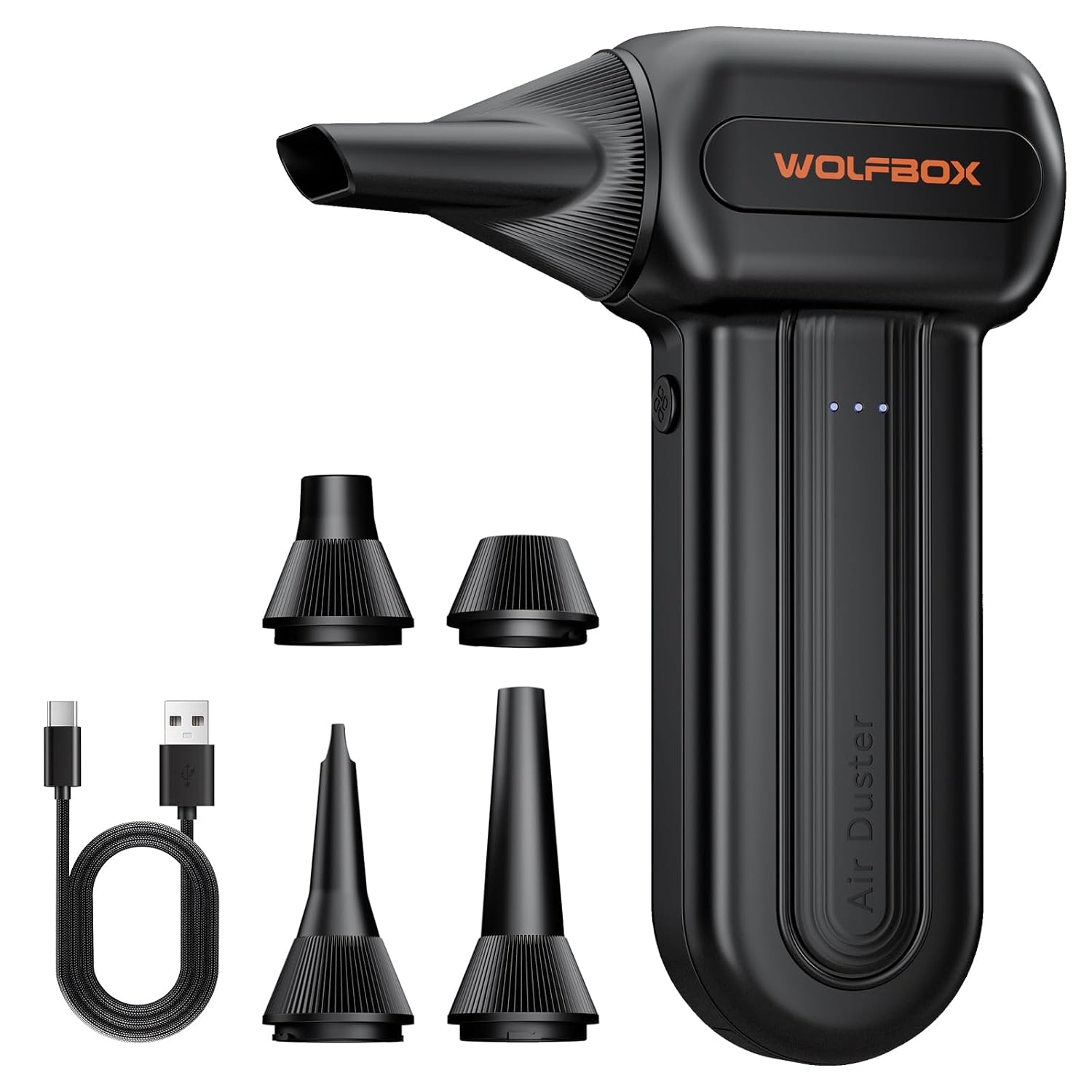
The WOLFBOX MF60 Cordless Electric Air Duster is listed at Rs 3,399 on Amazon.in with 4.6 stars across 1,600-plus ratings.
It ticks the two things that matter most: three power levels, so it is not stuck at a setting that scatters your keycaps, and five nozzles, which is what makes it usable on a vent slot and a seat seam and a fan blade. The rechargeable design is the whole point compared to cans. Its 110,000 RPM figure is a headline number rather than a guarantee, and we would read it as a signal that this is a genuine turbo blower rather than a toy, not as a promise of any particular airflow.
Who should skip it: anyone who cleans electronics once a year and is happy with a can, anyone hoping it will double as an outdoor blower, and anyone whose dust problem is greasy kitchen film rather than loose dust. At Rs 3,399 this only earns its place if you will reach for it regularly.
Common questions
Is it safe to use on a laptop?
Yes, with two precautions: use a lower setting, and stop the fan blades from spinning freely while you blow, either by aiming across the vent or by holding something gently against them.
Does it work on wet dust or spills?
No. Air moves loose particles. Anything damp, greasy or stuck needs wiping.
Can I take it on a flight?
Airlines treat these as lithium battery devices, so they belong in cabin baggage, not checked. Rules vary by airline and by battery capacity, so check before you fly. Ironically, canned air is the one that is banned outright.
How often should I clean laptop vents in India?
In a dusty city, or during construction nearby, every one to two months is reasonable. Elsewhere, twice a year is usually enough. The fan getting louder is the signal to look.
Disclosure: TechBelievers lists products from Amazon.in and other stores as an affiliate. If you buy through our links we may earn a commission, at no extra cost to you. Prices are checked periodically and change often on the store's own site.