Do Posture Correctors Work? An Honest Answer for Desk Workers
Spend nine hours a day at a laptop and your body adapts to the shape you hold it in. Shoulders roll forward, the upper back rounds, the head drifts ahead of the shoulders. By evening there is a dull ache between the shoulder blades that a hot shower half fixes.
Search for a solution and the first thing you will find is a posture corrector for a few hundred rupees, marketed with before and after photos and a lot of confidence. It is worth being clear about what that product does, because the marketing and the evidence do not line up.
What a posture brace physically does
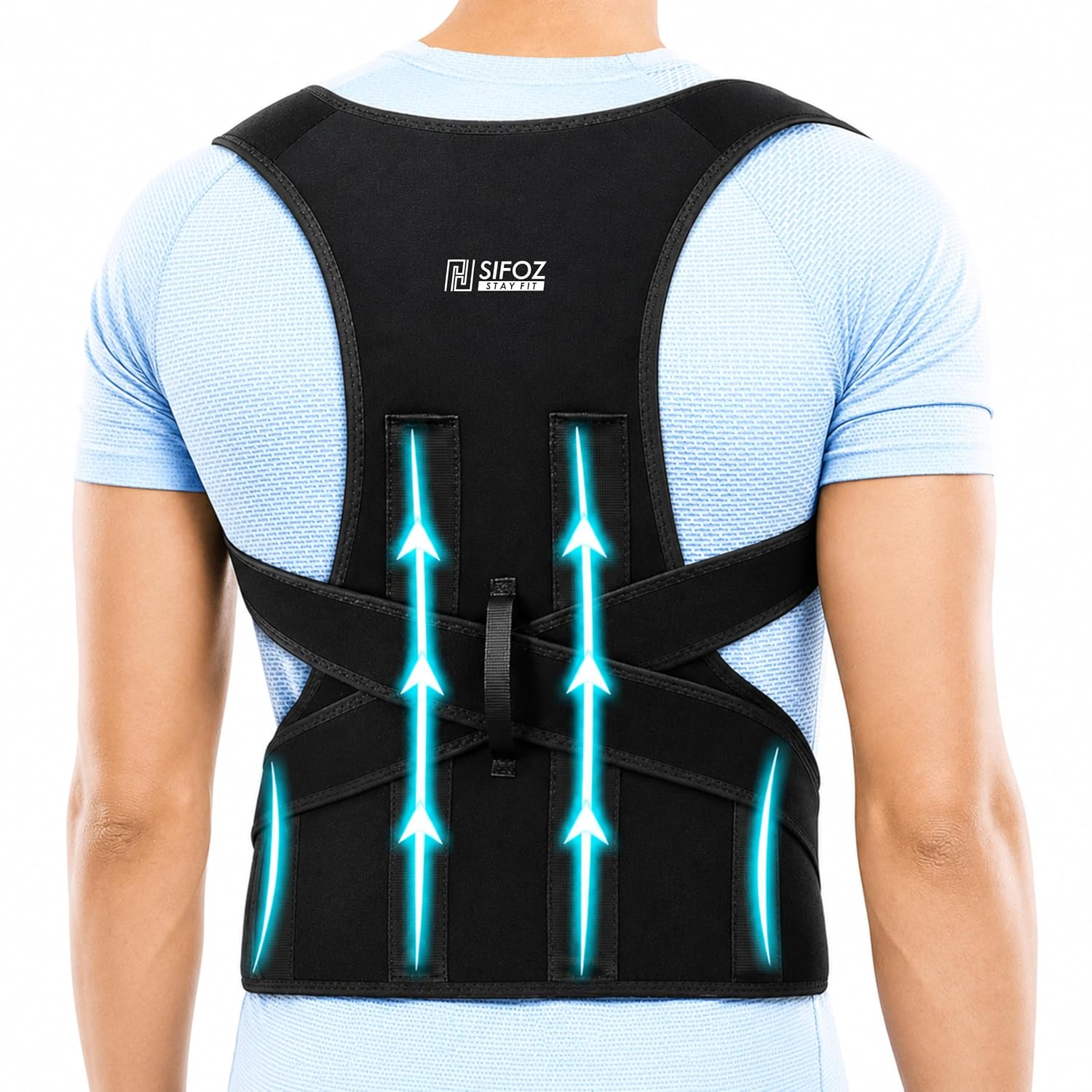
A typical brace is a figure-of-eight strap that goes over the shoulders and tightens across the upper back. When you slouch, the straps tighten and you feel it. That is the whole mechanism. It applies a light backward pull on the shoulders and gives you a physical cue when you round forward.
Notice what is missing from that description. It does not strengthen anything. It does not lengthen a tight chest muscle. It does not change a spinal curve. It is a reminder that you are wearing on your body.
The honest verdict
As a cue, it works. Most people who wear one for twenty minutes report that they sit noticeably taller during that time, and many notice the cue carries over for a while after taking it off. That is a genuine, if modest, benefit and it costs a few hundred rupees.
As a treatment, the evidence is thin. Posture research is messy, the studies that exist are small, and the causal link between posture and back pain is far weaker than the wellness industry implies. Plenty of people with textbook posture have back pain and plenty of people who slouch have none. The most consistent finding in the field is that the worst position for your back is whichever one you have been in for the last two hours.
So: useful as a nudge, oversold as a fix. Someone selling you a strap as a cure for back pain is going beyond what the product does.
The muscle weakening concern
The common warning is that wearing a brace makes your postural muscles lazy and dependent. In practice this is a concern about all-day wear and rigid supports rather than a soft strap worn for half an hour. If something is holding you up for eight hours a day, the muscles that would otherwise do that job have less to do.
The sensible approach is short sessions. Twenty to thirty minutes at a stretch, once or twice a day, tightened enough to feel the cue and not so tight that it holds you in place. If it leaves marks, digs into the armpits, or makes your hands tingle, it is far too tight. Numbness or tingling means take it off immediately, because that is nerve compression and not something to sit through.
What actually helps more
None of the following is as easy to buy as a strap, which is why the strap sells better.
To be clear, this is general information and not medical advice. A posture corrector is not a medical device. If you have a diagnosed spinal condition, are recovering from an injury, or are pregnant, check with a doctor or physiotherapist before using one.
What to look for if you buy one
The one we have listed
The Sifoz Adjustable Posture Corrector is on our deals list at Rs 439 on Amazon.in, rated 3.8 stars across more than 11,000 ratings.
That rating is worth reading properly rather than dismissing. Across this entire product category, ratings cluster in the high threes, and the negative reviews are overwhelmingly about two things: sizing and armpit chafing. Both are inherent to soft strap braces at this price. The positive reviews consistently describe it as a useful reminder rather than a transformation, which is exactly the right expectation.
At Rs 439 it is a cheap experiment. Treat it as a cue you wear for twenty minutes while you do the boring work of raising your monitor and getting up more often, and it earns its place. Treat it as the solution and you will be disappointed.
Common questions
How long should I wear a posture corrector each day?
Start at fifteen to twenty minutes and build up to no more than an hour in total. All-day wear is not the goal.
Can it fix a hunchback?
No. A fixed structural curve does not change with a strap. Postural rounding from habit can improve, but through strengthening and awareness rather than the brace itself.
Should I wear it while exercising?
No. It restricts natural shoulder movement, and during exercise is exactly when you want those muscles working freely.
My shoulders ache after wearing it. Is that normal?
Mild unfamiliar muscle fatigue in the upper back is common in the first few days. Sharp pain, pinching at the armpits, or tingling in the hands is not. Loosen it or stop.
Disclosure: TechBelievers lists products from Amazon.in and other stores as an affiliate. If you buy through our links we may earn a commission, at no extra cost to you. Prices are checked periodically and change often on the store's own site.