Digital Luggage Scales: What They Save You and What They Do Not
The moment is always the same. Your bag goes on the belt at check-in, the number comes up 24.6 against a 23 kilo allowance, and the agent looks at you. Now you are kneeling on an airport floor moving shoes into your hand luggage while a queue watches, or you are paying a per-kilo excess fee that on an international ticket can run into thousands of rupees for a couple of kilos.
A handheld luggage scale is a ₹600 device that makes that scene impossible. It is one of the few travel accessories where the value calculation is genuinely simple. But it is also routinely misunderstood, so it is worth being precise about what it does.
How a hook scale works
Inside the plastic body is a strain gauge — a small element that changes electrical resistance very slightly when it flexes. You hang the bag from the hook or strap, the body flexes under load, and the circuit converts that resistance change into a weight reading.
Two things follow. One, the reading needs the load to settle before it is accurate, which is why these scales beep or lock a figure a second or two after you lift. Two, the strain gauge is a physical component that can drift over years or after a hard knock, which is why occasional sanity checks matter.
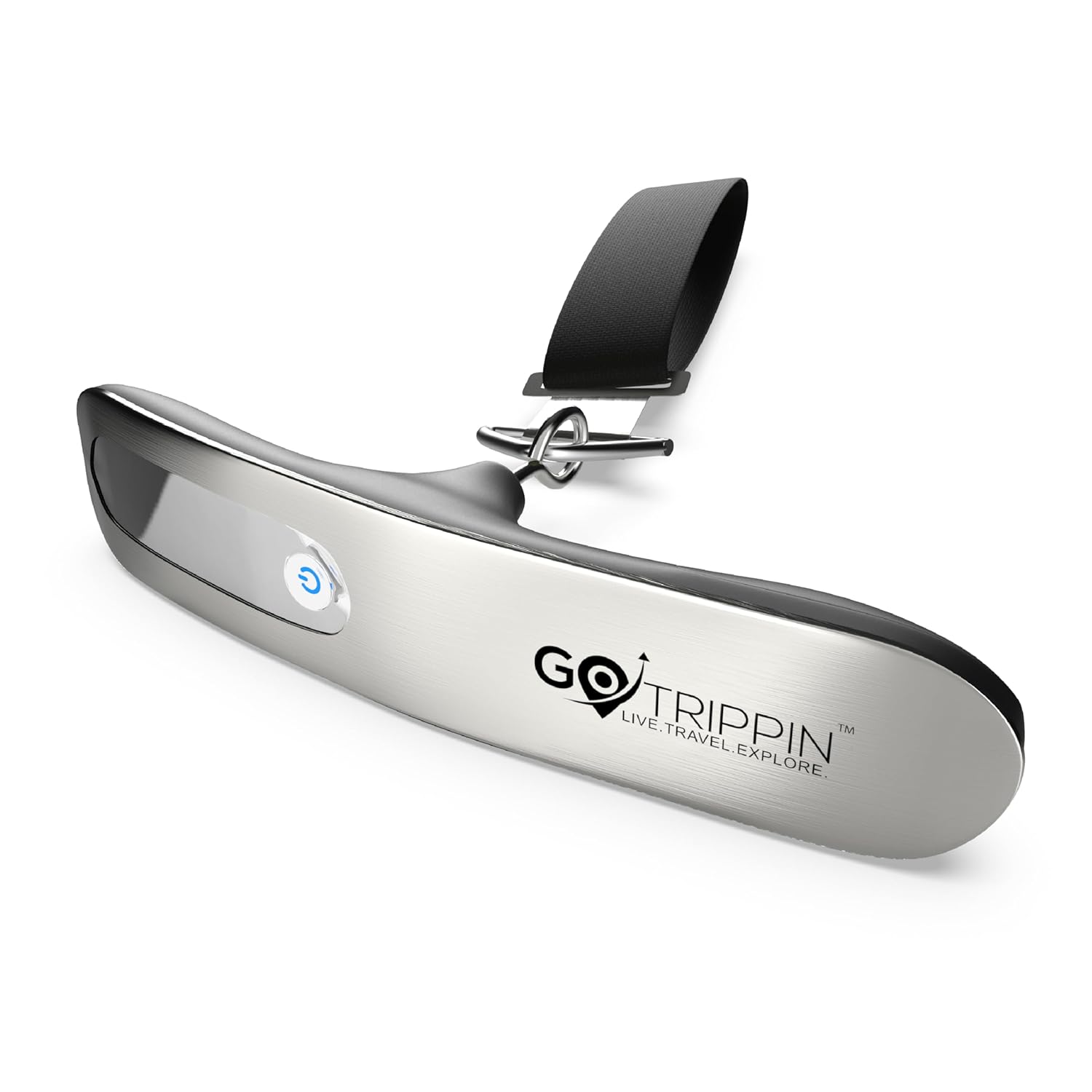
The usual form factor is a stubby handle with a strap or hook. You loop the strap through the suitcase handle, lift the bag clear of the floor, hold steady, and read the locked figure.
The specs that matter
Capacity. 50 kg covers essentially every checked bag you will ever pack. Anything less and you risk topping out on a family-sized suitcase.
Resolution and stated accuracy. Most scales in this class resolve to 10 or 20 grams and claim accuracy within about 100 grams. That is plenty when the airline limit is 23 kg. It is not laboratory equipment and does not need to be.
Auto-lock and backlight. The lock is the feature that makes the thing usable, because you cannot read a display on a scale you are holding above your knees while it fluctuates. A backlight matters more than it sounds, since half of packing happens at night before an early flight.
Battery type. Coin cells are common and last a long time, but if yours dies the night before a trip you need a spare, and CR2032s are not in every kirana shop.
The strap or hook itself. This is where cheap units fail. A thin strap on a stitched loop is the part that gives way with 20 kilos hanging off it.
Where it genuinely helps
The obvious case is international travel with a hard allowance, where excess fees are steep and charged per kilo. One avoided overage typically pays for the scale several times over.
The less obvious case is the return journey. Most people pack carefully on the way out and chaotically on the way back, after shopping, gifts and things relatives insisted on sending. A scale in your suitcase means you can redistribute at your destination, on a bed, calmly, instead of on an airport floor.
It also helps with the cabin bag, which airlines in India have been weighing far more strictly than they used to. A 7 kg limit is easy to breach with a laptop, a charger, a water bottle and a book.
And it is useful outside travel entirely — weighing a parcel before booking a courier, or checking a gas cylinder's remaining contents, both work fine on a hook scale.
Where it disappoints
Your reading and the airline's reading will not match exactly. Their platform scale is calibrated and certified; yours is a consumer device being held by a human arm. Treat your number as approximate and leave yourself half a kilo of headroom rather than packing to exactly 23.0.
Lifting technique affects the result. If you jerk the bag up, the strain gauge sees a momentary spike. Lift smoothly, let it settle, then read.
Very heavy bags are awkward to weigh. Holding 28 kilos steady at arm's length is unpleasant, and if you have a back problem it is a bad idea. The workaround — stand on a bathroom scale with and without the bag and subtract — is less precise but easier on you.
And the honest caveat: if you only fly domestic with generous allowances, or you travel light by nature, you will use this twice a year at most. That is not a criticism of the product, just a reason some people genuinely do not need one.
Packing around it
Weigh before you close the bag, not after, so you can still move things. Keep the heaviest items — shoes, books, bottles — in whichever bag has the most headroom, and remember that airlines rarely weigh a personal item, so a laptop bag is where the dense things should go.
If you find yourself over by a kilo repeatedly, the problem is usually volume rather than weight discipline. Compression packing cubes will not reduce mass, but they will show you clearly what you are actually carrying, which tends to prompt honest decisions about the third pair of jeans. For the road-trip half of travelling, a back-seat organiser handles the same problem in a car boot.
The one we have listed
We list the GoTrippin Digital Luggage Scale at ₹619 on Amazon.in, rated 4.5 stars across 15,000+ ratings. That review count is worth pausing on — at fifteen thousand ratings, a 4.5 average is a much stronger signal than the same score on a product with two hundred reviews.
It is a handheld unit rated to 50 kg, which covers any checked bag, and it weighs a suitcase in seconds at home. At a shade over ₹600 it costs less than a single kilo of international excess baggage on most carriers, which is the entire argument for owning one.
Skip it if you mainly fly domestic with a 15 kg allowance you never approach, if lifting a full suitcase clear of the floor is difficult for you, or if you already own a bathroom scale and are happy with the subtract-the-difference method.
Common questions
How accurate are these really?
Typically within about 100 grams under steady lifting, which is far tighter than any airline limit requires. Errors come mostly from jerky lifting rather than the sensor.
Why does the airline scale read differently from mine?
Theirs is a certified platform scale, yours is a handheld consumer device. Small disagreements are normal. Pack with half a kilo of margin and it never matters.
Can I weigh my cabin bag with it?
Yes, and you probably should. Cabin weight limits in India are enforced more often now than they were a few years ago.
What if the bag is too heavy to lift?
Stand on a bathroom scale holding the bag, then without it, and subtract. Less precise, but no lifting at arm's length.
Disclosure: TechBelievers lists products from Amazon.in and other stores as an affiliate. If you buy through our links we may earn a commission, at no extra cost to you. Prices are checked periodically and change often on the store's own site.