Cable Management Boxes: What They Hide and What They Do Not
Pull the chair out from under any desk that has been in use for two years and you will find the same thing. An extension board lying on the floor, three adapters hanging off it at odd angles, a laptop brick that is warm to the touch, and a knot of slack cable holding a season of dust. Behind the TV it is worse, because nobody has moved that unit since it was installed.
Most people deal with this by tying the cables together and calling it done. That helps for about a month. The reason it does not last is that the ugly part was never the cables, it was the board and the adapters, and no amount of tying makes those look better.
What a cable box actually is
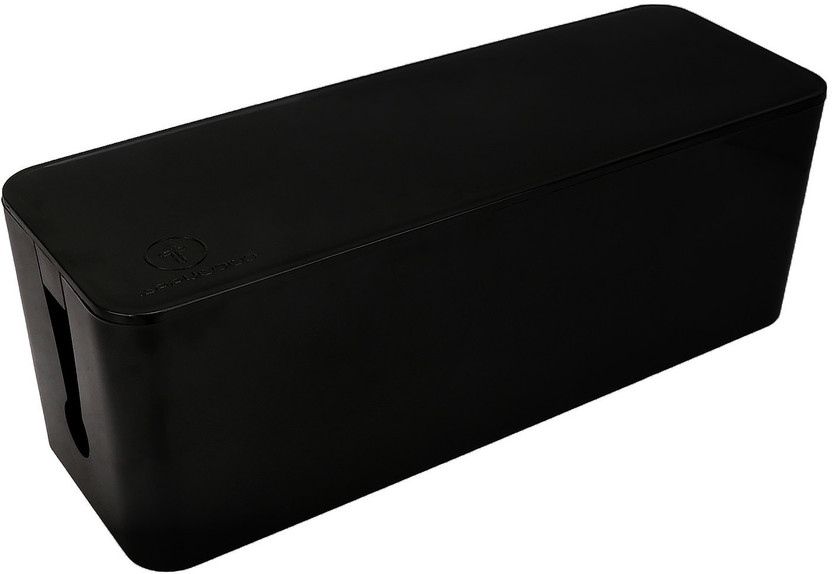
A cable management box is a plastic or fabric-covered container with slots cut into the ends and a removable lid. The extension board sits inside. Plugs and adapters stay plugged in inside the box. Cables run out through the side slots to whatever they power, and the lid closes over the top.
It is worth being clear about the difference between the three products people mix up. A tray screws or clamps under a desk and lifts the board off the floor without covering it. Clips and sleeves bundle cables along a route. A box hides the board and the adapters from sight and from dust. They solve related but different problems, and buying the wrong one is the most common mistake in this category.
The things that matter when choosing one
Internal size, not external size. Listings quote outer dimensions. What you need is the length of your extension board plus room for the adapters, which stick out and often sit at an angle. Indian boards with six sockets are commonly around 30 to 35 cm, and a 40 cm box that fits the board perfectly can still be useless once three chunky adapters go in. Measure the board with everything plugged in.
Ventilation. This is the one worth caring about. Adapters and laptop chargers run warm, and a sealed plastic box traps that heat. Good designs have vents in the base or gaps at the ends. A box with no airflow at all, packed with six adapters, gets hot enough to matter over a long day.
Slot design. Wide, soft-edged slots are what you want. Narrow ones force you to unplug a cable to get it out, and sharp moulded edges press into the insulation of thin cables over months.
Material. Hard plastic holds shape and takes a wipe. Fabric-covered boxes look better in a living room and are easier to squash into a shelf, but they collect dust and are harder to clean. If it is going under a desk where nobody looks, plastic is the sensible choice.
Whether the lid stays put. A lid that lifts off entirely is fine behind a TV. Under a desk, where your knee hits it, a lid that clips or sits in a recess is worth the small extra.
Where a box genuinely helps
Under a desk is the clearest case. It keeps the board off the floor when the housekeeping mop comes through, it stops the dust layer that builds up on exposed sockets, and it means you are not looking at four glowing LEDs while you work.
Behind a TV unit it is mostly cosmetic, and that is a legitimate reason. A set-top box, a router, a soundbar and a TV between them produce an unattractive pile of adapters, and one box takes that from visible to invisible.
In a house with a toddler or a cat, the safety case is real. Loose sockets at floor level are exactly at crawling height, and cats chew slack cable. A closed lid removes both temptations without you having to rewire anything.
Renters get particular value here because nothing is drilled. The box sits on the floor or on a shelf and leaves with you.
Where it disappoints
It does not reduce the number of cables. Everything that came out of the board still comes out of the box, so if your visible mess is the six cables running up to the desk surface, a box changes almost nothing. That job belongs to clips, sleeves or shorter cables.
Heat is a genuine limitation, not a theoretical one. A high-wattage laptop charger and a couple of other adapters in a sealed box will sit warmer than they would in open air. Do not put anything with a heating element or a large power brick in a closed box, and leave the lid slightly open if it feels hot.
Access becomes annoying. If you unplug and replug things often, a lid is one more step every time, and most people eventually leave it off.
A box on the floor still sits in the mop's path during monsoon, when floors get wiped constantly and stay damp. On the floor a box is safer than a bare board, but the actually correct answer is to get it off the floor.
Who should skip this: anyone whose complaint is the visible cable runs rather than the board itself, anyone who plugs and unplugs equipment daily, and anyone running high-draw appliances through the strip. Those need a tray, open clips, or a properly rated wall socket respectively.
Setting it up sensibly
Put the highest-wattage adapter closest to a vent or a slot, and leave a socket empty next to it if you have one spare.
Coil slack cable in a loose figure of eight rather than a tight roll. Tight coils of live cable heat marginally more and crease the insulation at the same point every time.
Feed cables so the heavy ones exit at the bottom of the slot. That stops the whole box being dragged along the floor when someone tugs a laptop charger.
Open it and blow the dust out twice a year. A closed box collects far less dust than an open board, but it does still collect it.
The one we have listed
We currently list the APPUCOCO Cable Management Box at Rs 362 on Flipkart against a Rs 1,299 MRP, rated 4.4 stars across 112 ratings. It takes an extension board and its adapters, cables exit through side slots, and the lid keeps dust, toddlers and pets out. The rating count is small, so treat it as an early signal rather than a settled verdict.
If your problem is the board sitting on the floor rather than the look of it, an under-desk cable tray gets the whole thing off the ground without any drilling, and the two work well together. And if the mess you actually see is charging cable slack on the desk surface, a retractable USB-C cable removes it at the source.
Common questions
Is it safe to close an extension board inside a box?
For normal desk and TV loads with a vented box, yes. It stops being sensible when you add high-draw appliances or a large fast-charging brick to a sealed box. If the outside of the box feels warm, take the lid off.
How do I know what size to buy?
Measure your extension board with every adapter plugged in, then add about five centimetres of margin. Adapters, not the board, are what make boxes too small.
Will it stop my cat chewing the wires?
It removes the wires inside the box from reach. The cables running out of it are still exposed, so pair the box with a sleeve if that is your actual problem.
Plastic or fabric?
Plastic under a desk, where cleaning matters more than looks. Fabric in a living room, where it has to sit on an open shelf and be seen.
Disclosure: TechBelievers lists products from Amazon.in and other stores as an affiliate. If you buy through our links we may earn a commission, at no extra cost to you. Prices are checked periodically and change often on the store's own site.