Are Cheap Massage Guns Worth It? What Under Rs 2,000 Actually Gets You
Five years ago a percussion massage gun was a physio's tool. The well-known brands sold them for the price of a mid-range phone, and the sales pitch leaned heavily on professional athletes. Today you can pick one up on Amazon.in for less than what a decent pair of running shoes costs, and the reviews sections are full of software engineers and school teachers rather than sprinters.
That drop in price is real, but it raises a fair question. If a massage gun cost Rs 15,000 in 2020 and a similar-looking one costs Rs 1,799 now, what got cut?
What a massage gun is actually doing
The mechanism is simple. A small motor drives a head back and forth, tapping into the muscle somewhere between 1,800 and 3,200 times a minute. The tapping increases blood flow to the area and, for most people, reduces the tight guarded feeling you get after a long drive, a heavy gym session, or eight hours hunched over a laptop.
It is not doing anything magical. A tennis ball against a wall does a version of the same job. What the gun buys you is reach, consistency, and the ability to work on your own shoulders without asking anyone for a favour.
The four things that separate a good one from a bad one
1. Amplitude
This is how far the head travels on each stroke, and it matters more than the speed number on the box. Professional units move about 12 to 16 mm. Budget units usually sit around 6 to 10 mm. The practical difference: a shallow stroke feels pleasant on the surface of a muscle but does not reach into a properly knotted calf or glute. For desk-related neck and shoulder tightness, shallow is genuinely fine. For serious post-training soreness in large muscles, you will notice the limit.
2. Stall force
Press the head into your shoulder and lean on it. On a cheap unit the motor stalls and the tapping stops. That is stall force, and it is the spec manufacturers are least likely to publish. Anything that keeps running under moderate pressure is doing its job. If it stops the moment you apply real weight, you will find yourself holding it lightly, which defeats the point.
3. Noise
Older motors were loud enough that you could not use one while watching television. Newer brushless ones are much quieter. Read the reviews for this specifically, because it is the single most common complaint and the spec sheets never mention it.
4. Battery and weight
Most units in this range run two to four hours on a charge, which is plenty for personal use. Weight matters more than runtime. A gun that weighs 900 grams gets tiring to hold above your own shoulder after ninety seconds, which is roughly how long you need to spend on each spot.
Where the budget models cut corners
Read enough Indian buyer reviews on these and the pattern is consistent. The cheaper units are fine on day one, and the failure points show up later:
How to use one without making things worse
This part gets skipped in most product descriptions, and it is the part that actually decides whether you like the thing.
Worth stating plainly: this is general information, not medical advice. If you have a persistent injury, a circulation condition, are pregnant, or take blood thinners, ask a doctor or physiotherapist before using percussion therapy. A massage gun is not a medical device and does not treat anything.
Who should probably skip it
If your tightness comes from sitting badly for nine hours a day, a massage gun treats the symptom every evening and does nothing about the cause. A chair adjustment, a monitor raised to eye level, and standing up every hour will do more. The gun is a reasonable addition to those changes, not a replacement.
Equally, if you already get regular physiotherapy for a specific problem, ask your physio first. They may want you working a particular area and leaving another alone.
The one we have listed
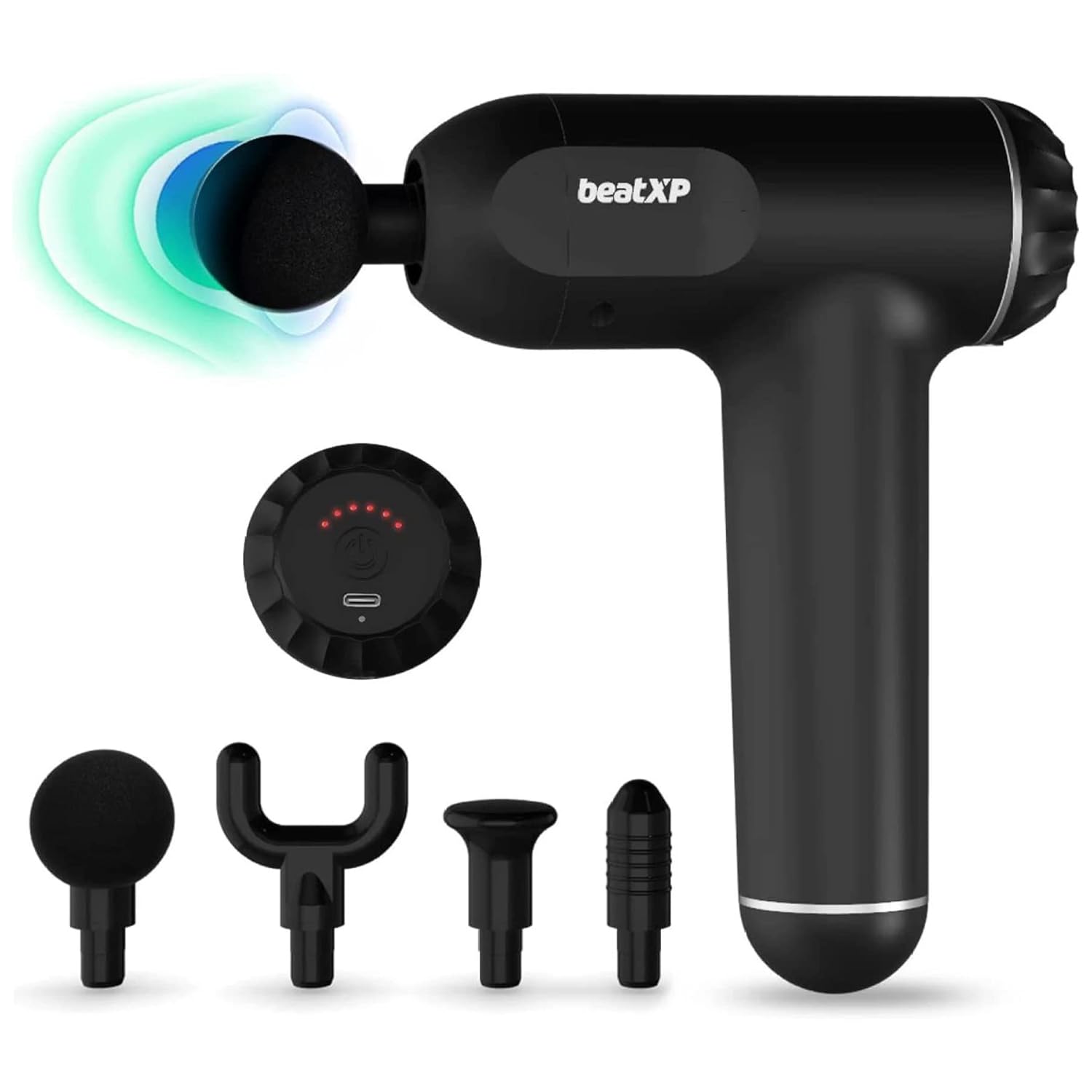
The Bolt Deep Tissue Massage Gun sits at Rs 1,799 on Amazon.in at the time of writing, with a 4.4 star average across more than 6,700 ratings. That volume of feedback is the main reason it is on our list. In this price band the specs are broadly similar across a dozen near-identical units, so a long and consistent review history is a more useful signal than any spec sheet.
It ships with multiple heads and speed settings, which covers the normal cases: a flat head for large muscle groups, a bullet head for specific knots, and a fork head for either side of the spine. Prices on Amazon move around, so check the current one before you buy.
Common questions
How often can I use a massage gun?
Daily is fine for most people if you keep sessions short and keep the head moving. Twice a day on the same muscle is more than you need.
Will it help with back pain?
It may ease general muscular tightness around the back. It will not address anything structural, and back pain has enough possible causes that self-treating for weeks is a bad idea. See a doctor if it persists.
Is a more expensive one noticeably better?
Yes, in amplitude, stall force and build quality. Whether that gap is worth five times the money depends on whether you are treating gym soreness or desk stiffness. For the latter, the budget units are enough.
Can I use it on my neck?
Only on the muscle at the back and sides, gently, on the lowest speed. Never on the front or sides of the throat.
Disclosure: TechBelievers lists products from Amazon.in and other stores as an affiliate. If you buy through our links we may earn a commission, at no extra cost to you. Prices and availability are checked periodically but change often on the store's own site.