A Cordless Tyre Inflator Is the Most Boring Useful Thing in Your Boot
Nobody buys a tyre inflator because they want one. You buy one after the third time you pulled into a petrol pump, waited behind two autos, and found the air machine either out of order or reading nonsense. Or after a slow puncture went unnoticed for a week and chewed through the shoulder of a tyre that had 20,000 km left in it.
It is a dull purchase. It is also one of the few car accessories that pays for itself in a measurable way.
Why tyre pressure matters more than people think
Under-inflated tyres do three things, all bad. They increase rolling resistance, which costs you fuel. They flex more at the sidewall, which builds heat and shortens tyre life, particularly on a long summer run on the highway. And they change how the car behaves under braking and in a corner, usually making it vaguer and slower to respond.
None of this announces itself. A tyre can be 6 to 8 psi low and look completely normal. Radial tyres are designed to look full even when they are not, which is exactly why the problem goes unnoticed until the wear pattern gives it away.
The usual advice is to check monthly. Realistically, most people check when someone tells them to. Having a pump in the boot moves the check from a trip to a two-minute job in the parking area.
The three types you will see
12V corded
Plugs into the car's cigarette lighter socket. Cheapest option, usually Rs 800 to Rs 1,500. Works fine, but you are tethered to the car, the cable has to reach all four wheels, and the car needs to be on or in accessory mode. Also useless for a cycle in the building basement.
Battery powered cordless
Has its own lithium cell, charges over USB-C, and works anywhere. Typically Rs 2,000 to Rs 4,000. You get freedom of movement and the ability to help someone else's vehicle without a socket. The trade-off is that a flat battery in an emergency is a real possibility, so most decent models also accept a 12V input as backup.
Manual foot or hand pumps
Cheap, indestructible, and genuinely hard work on a car tyre. Fine for a cycle. For a sedan going from 26 to 33 psi across four wheels, you will be there a while.
What to actually check before buying
What pressure should you actually run?
Not the number on the tyre sidewall. That is the maximum the tyre can take, not what the car wants. The correct figure is on a sticker inside the driver's door frame, sometimes inside the fuel flap or in the owner's manual, and it usually lists two values: normal load and full load.
Most small Indian hatchbacks sit somewhere around 29 to 33 psi. Compact SUVs a little higher. If you are carrying five adults and luggage to the hills, use the full-load figure, not the everyday one.
Two practical notes. Check pressure cold, meaning the car has been parked for a few hours or driven less than a couple of kilometres, because a hot tyre reads several psi higher. And do not bleed air out of hot tyres on a highway break to hit the sticker number, or you will be under-inflated once they cool.
The nitrogen question
Nitrogen filling is heavily marketed at Indian tyre shops. The claim is that nitrogen molecules leak more slowly and pressure stays stable across temperature swings. Both are true and both effects are small in ordinary use. Regular air is already about 78 percent nitrogen. If your tyre shop fills nitrogen for free, take it. Topping up with ordinary air from your own pump in between does not undo anything.
The one we have listed
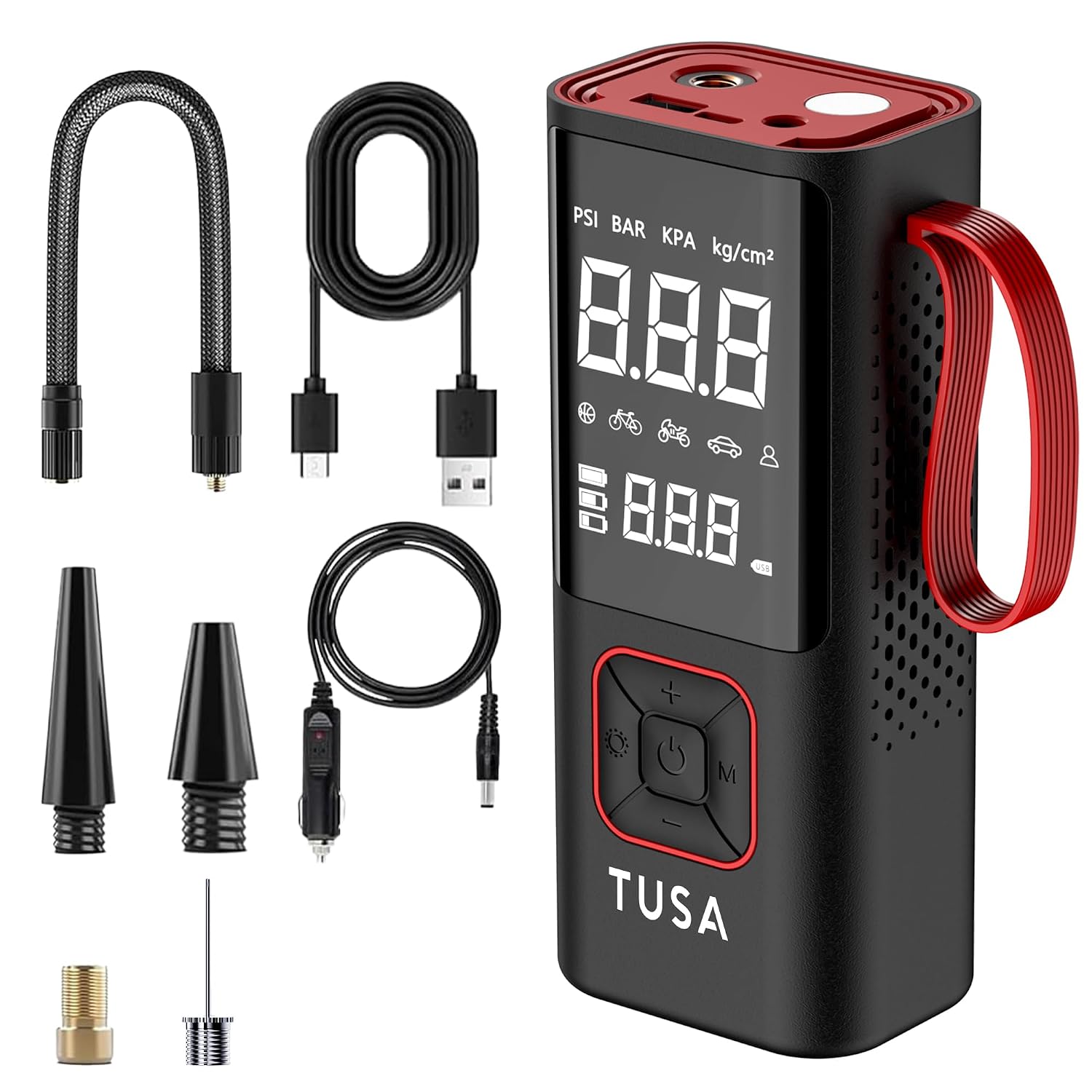
The TUSA Storm X Cordless Tyre Inflator is on our deals list at Rs 2,949 on Amazon.in, rated 4.1 stars across roughly 2,600 ratings. It runs off its own battery or a 12V car socket, and has a preset pressure with auto cut-off, which is the feature we would not buy without.
The 4.1 rating rather than 4.5 is worth reading into. Across this category the recurring complaints are gauge accuracy off by a couple of psi and the unit getting warm on longer jobs. That is normal for small compressors at any price under about Rs 6,000. For topping up tyres, which is what most people use it for, it is a non-issue.
Common questions
Can it inflate a completely flat tyre?
Yes, but slowly, and the unit will get hot. Also worth remembering that a fully flat tyre may have come off the bead, in which case a small compressor cannot reseat it and you need a workshop.
Will it work on bike and cycle tyres?
Yes. Motorcycle tyres are quick. Cycle tyres need the Presta adapter if you have a road bike, and you should set a much higher target pressure, often 80 to 100 psi.
How long does the battery last?
Most models in this range handle one full car's worth of top-ups on a charge, sometimes two. Charge it every few months whether you use it or not, since lithium cells self-discharge.
Is it safe to leave in the car in summer?
A closed car in an Indian summer gets extremely hot, which is not kind to lithium batteries over time. If you can, store it in the boot rather than the cabin, and bring it inside occasionally.
Disclosure: TechBelievers lists products from Amazon.in and other stores as an affiliate. If you buy through our links we may earn a commission, at no extra cost to you. Prices change often on the store's own site, so check before ordering.